47 browser tabs open this Christmas: Why Gen Z is Opting Out of Leadership Roles

Gen Z is opting out of leadership roles due to excessive administrative burdens. This article explores the generational differences in coping with these challenges and offers solutions for organisations.
Maybe it’s less than 47 tabs (across all devices?)
But when you live the ‘40% problem’ you are tired of counting (even when it’s the only thing you feel awake enough to do).
40% problem? The percentage of time that managers and leaders are buried in admin. (Deloitte 2025)
And despite all the automations, processes and systems this isn’t getting better.
Here's what organisations miss: the type of admin affecting each generation is different, and nobody's learning from each other's coping mechanisms.
Only a tiny percentage of Gen Z aspires to leadership positions. When they watch their managers stay late to ‘power through’ the paperwork, they conclude that whatever leadership was supposed to be, it isn't this.
So how does it vary across the generations and what can organisations do about it?
Here’s 4 aspects to consider.
TL;DR
Maybe it's fewer than 47 browser tabs (across all devices?), but when you live the '40% problem' you're too tired to count. That's the percentage of time managers and leaders spend buried in admin according to Deloitte 2025. Despite all the automations, processes and systems, this isn't getting better. Organisations the type of admin affecting each generation is different, and nobody's learning from each other's coping mechanisms. The solution isn't one generation teaching another - it's combining all four approaches. Rather than expecting Gen Z to accept dysfunctional systems, organisations need to redesign leadership roles that reflect what leadership was meant to be: developing people, not managing spreadsheets.
1. Generational variations
I’ll start with the usual rider that variations within generations are much bigger than those between them. So these are stereotypes but you may recognise something pertinent to you.
Boomers - drowning in compliance reporting they never signed up for when they entered leadership.
Gen X - stuck translating between ‘tried and tested’ old systems and new tools.
Millennials - managing endless messaging threads and whatsapp groups that masquerade as collaboration.
And Gen Z?
They watch the addiction to the admin overload and decide that if leadership is about this and not developing people or the organisation, they're opting out entirely.
But the admin load isn't a Gen Z problem. It's everyone's problem. The difference is that Gen Z is refusing to pretend otherwise.
The ability to ‘power through’ and stay late is no superpower when the tasks could have been avoided or automated. A lack of control over communications costs everyone, as does an absence of succession planning.
The solutions, as ever, lie in combining approaches and different generations learning from each other. What if these weren’t competing strategies but complementary ones?
That is a leadership issue to resolve, which requires taking people out of their comfort zones and finding another way forward. Don’t leave people in their corners.
2. Make leadership, not admin, your priority
No one takes up a leadership position because they love the admin. They want to develop others, shape organisational culture and drive meaningful change.
Activities which require uninterrupted thinking time, the ability to have genuine conversations and the mental space to consider strategic questions. Admin dominated jobs eliminate all three.
Gen Z isn't rejecting leadership. They're rejecting admin with a management title attached.
So when they complain at not being able to get hold of their line manager to ask for advice, but then find themselves receiving email after email from them, it doesn’t inspire.
Making leadership your priority means naming the problem. Actually work it out - is it 40% for you or is it even worse? Are you carrying on as you always have as it is what you have always known?
Accepting the administrative burden as an inevitable consequence of leadership will mark you out as a dinosaur in this day and age. Automating bad processes is not the answer either.
What percentage of your time do you want to lead?
How many hours a week do you want to be leading for?
These might seem like ridiculous questions but it is a lot more ridiculous to avoid answering them.
You will never get the admin load down to 0%. But you could halve it. You could reduce leaders’ working hours and ensure better decisions get made.
3. Generational coping mechanisms
The alternative title to this is ‘why no one is learning from each other’.
Whilst a Boomer approach of ‘stay late and power through’ can mask inefficiency and a reluctance to change, there are also lessons for others. The discipline involved in systematically clearing the backlog has merit even if others may not wish to replicate the methodology.
Gen X learned to create workarounds when modern solutions didn't exist and document processes that existed only in people's heads. They were helpful at the time, and still are when the app you need is yet to exist, but also had a ‘use by’ date.
The problem isn’t that they are clunky, but that organisations fail to modernise, leaving Gen X (and their colleagues) to maintain complex workarounds that eventually become institutional knowledge (that nobody else possesses).
Millennials' drive to automate stems from genuine insight about technology's potential to eliminate repetitive tasks. When they succeed, the time savings benefit everyone. When they fail, it's usually because they're trying to automate processes that shouldn't exist in the first place. Their comfort with technology and willingness to experiment with new tools provides value across the organisation.
Gen Z's approach of ‘question whether we need to do this at all’ represents the most radical intervention, which is why it's also the one that leaders most instinctively resist. Yet it’s a great question not asked by those in ‘leadership’ roles which are super-manager positions rather than genuinely strategic ones.
Getting it right means combining institutional resilience, systems thinking, automation capability and willingness to challenge assumptions. When you do it from the shop floor upwards great outcomes are possible.
But if the conversation never happens it will stay where it is - the leader’s job is to begin that conversation.
4. When meetings become the work
Don’t get me wrong - meetings can be great.
I’m not joking, seriously great - highlight of the week, the ‘look at what we are doing here, haven’t we just made great progress’. And so on.
The principle of meetings is not a problem. The problem is when they achieve nothing and become the practical alternative to work.
The reality of ‘47 browser tabs’ only becomes so when people are trying to do so many things at once before they have to trudge off to the next meeting.
Multigenerational workplaces often reveal starkly different relationships with meetings.
Boomers generally accept meetings as necessary leadership activity, viewing face-to-face discussion as how important decisions happen. In a pre-digital world synchronous communication was the only game in town.
Gen X transformed meetings into structured events with agendas, minutes, and action points. They professionalised what Boomers handled informally, creating systems that (theoretically) improved meeting effectiveness. The unintended consequence was normalising meetings as default communication method rather than occasional necessity.
Millennials inherited meeting culture but added layers of complexity through platform proliferation. They'll have video calls, Slack huddles, email threads and collaborative documents all addressing the same topic because different platforms suit different communication needs. Their comfort with technology means they're genuinely collaborating BUT the coordination overhead can be immense.
Gen Z watches this meeting madness and asks the question everyone else stopped asking: (deep breath) DO WE ACTUALLY NEED TO HAVE A MEETING??
Their preference for asynchronous communication for large chunks of a meeting cycle isn't antisocial behaviour. It's efficiency. They recognise that most meetings could be eliminated if information were documented clearly and decisions had explicit owners.
The meeting paradox is that we've convinced ourselves coordination requires synchronous time when often it requires clear thinking documented well. Leadership roles consumed by meetings aren't leadership roles. They're coordination roles disguised as leadership.
Remember that
Administrative burden varies by generation and generally stems from work norms in formative years. Getting past that element is generally the biggest barrier.
The 40% admin versus 13% people development split in leadership roles represents a fundamental inversion of priorities that makes leadership unattractive to Gen Z. They still want to lead, but not on these terms. The leadership pipeline crisis isn't a Gen Z motivation problem.
Recruiting and retaining Gen Z into leadership requires demonstrating through action that leadership roles provide meaningful opportunities, not just managing increasingly complex administrative systems ‘enabled’ by technology.
FAQ
Why is Gen Z so reluctant to pursue leadership positions compared to previous generations?
Gen Z's reluctance stems from rational observation rather than generational deficiency. They're watching current leaders across all generations spend more of their time on administrative tasks than on people development. When leadership appears to be primarily about managing compliance systems, coordinating across platforms and staying late to complete paperwork, Gen Z concludes the role isn't worth the sacrifice. This is efficiency not entitlement.
How can organisations reduce administrative burden on leaders without compromising necessary compliance and systems?
The best answer to that is compliance and systems will be protected if the administration works well. There’s also a question about whether existing practice should be protected.
Question every administrative task: does this genuinely require senior judgement, could it be handled by capable administrators, or should it exist at all? Gen Z's questioning approach proves valuable here. Many administrative requirements exist because ‘we've always done it this way’ (the 6 most dangerous words in business) rather than serving genuine organisational needs.
Alex Atherton is a generations speaker who helps organisations navigate intergenerational workplace challenges, particularly around recruiting and retaining Gen Z into leadership roles.

How can I help you?
Talks, workshops and seminars - I am a generations speaker and Gen Z speaker specialising in the multigenerational workplace. My talks include recruiting and retaining Gen Z, understanding Gen Z characteristics, and overcoming challenges in age diversity. Speaker showreel here.
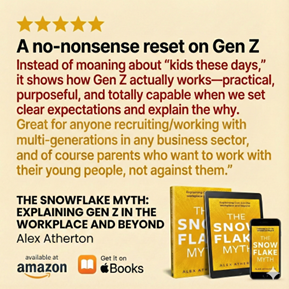
My book The Snowflake Myth is out now - to receive a free chapter please click here.
One to one coaching programmes for senior leaders who are swamped by their jobs so they can thrive in life. Click here to discover where you are on your journey from Frantic to Fulfilled? Just 5 minutes of your time and you will receive a full personalised report with guidance on your next steps.
Team coaching programmes - working IN a team is not the same as working AS a team and yet they are often treated as if they are the same. I help teams move from the former to the latter, and generate huge shifts in productivity and outcomes.