Are you ready for the Five-Generation Workplace?
Have you looked around your office lately?
The 22 year old Gen Z recruit is sitting three desks away from a 72 year old Baby Boomer who came out of retirement because they weren't done yet.
That is not a quirk. It is the new normal.
But I hear you say, that is only four generations! And you are right (Boomers, X, Millennials, Z).
Yet already 35,000 to 40,000 members of the UK workforce are 80 or older and from the so-called Silent Generation. And in only three years’ time the oldest Gen Alpha will join the ‘working age’ statistics.
The truth is that we will move from five to SIX generations pretty quickly. But I digress.
The Future of Work is not just about A.I. and remote working. It is also about a workforce where increasingly the older generations stay rather than depart.
How can this drive productivity rather than impact negatively on the bottom line?
Here’s four aspects to consider.
TL;DR
The five-generation workplace is now standard across UK organisations, with Traditionalists through to Gen Z often working side by side. Most leaders feel unprepared for this, and the evidence shows it is costing organisations in turnover, engagement and missed opportunity. Success requires replacing the one-size-fits-all approach with genuine curiosity about what motivates different cohorts — without stereotyping individuals. The returns, in productivity, retention and innovation, are substantial.
1. Preparing for generational complexity
The statistics make for uncomfortable reading.
CIPD research indicates that 62% of leaders feel unprepared to manage this degree of generational complexity.
That’s a large majority who are not prepared for a problem that is ALREADY HERE.
In plenty of organisations it is creating more issues than it solves.
Communication styles clash. Expectations diverge. Motivations differ.
What earns loyalty from a Boomer can actively alienate a Gen Z employee, and vice versa.
The temptation is to treat everyone the same in the name of fairness. That instinct is the management equivalent of giving everyone the same size shoe.
The multigenerational workplace will not sort itself out. The organisations who are getting this right are not doing anything particularly mysterious.
They are simply paying attention. They are asking better questions and resisting the urge to stereotype.
In my book The Snowflake Myth, I argue that much of what we believe about younger workers is rooted in misunderstanding rather than reality.
The same applies to the way we think about generational differences more broadly. Understanding each cohort's formative context is not a nice-to-have; it is a core professional skill.
Your starting points should be considering
Are you just dealing with issues as they come up, rather than working out a strategy?
What are the biggest issues you are yet to resolve in your organisation?
2. Know Your Cohorts — but don't stop there
The starting point is understanding who is in the room.
Let’s start with considering unhelpful stereotypes.
Silent Generation (born 1925-45) may bring deep loyalty and a preference for formal hierarchies.
Baby Boomers (1946–1964) are achievement-oriented, motivated by status and visible progress.
Generation X (1965–1980) are…you get the picture.
These broad profiles are useful starting points for potential trends, not final destinations.
The danger is treating trends as a permission slip to stereotype.
In The Snowflake Myth, I argue that the moment you stop seeing individuals and start seeing only their generational label, you have undermined the very thing you were trying to understand.
Use the cohort characteristics as a lens, not a verdict.
Generational trends tell you where to look; they do not tell you what you will find.
The best multigenerational workplace leaders combine awareness of generational patterns with genuine curiosity about the specific person in front of them first and foremost.
Know your context, absolutely, but use it as a platform to know your people.
3. Succession planning cannot wait for the crisis
Many UK organisations have an urgent, and unaddressed, problem.
The people who carry their institutional knowledge, client relationships and operational expertise are closer to retirement than anyone round the top table is comfortable discussing.
The five-generation workplace creates an opportunity to address this deliberately. Choosing to ignore it until the departure of two or three key individuals creates an emergency is not a strategy.
Effective succession planning in a multigenerational context is not simply a matter of identifying high-potential individuals.
It requires creating genuine knowledge transfer mechanisms, overview of skills and building leadership pipelines that reach down into Millennial and Gen Z cohorts.
At a basic level it also means knowing the age profile of your workforce. If you have fewer members of staff with each generation coming through (and you might, check it out) you will not replace like with like from within.
Hiring externally does not have to be an issue, but you should know whether you will be forced into it.
And the fact is that hundreds of thousands of Gen Z are already in leadership roles, but the key is that they are doing it in their own organisation.
The best and brightest may choose to lead, but not for you. And middle leadership is already considered to be too ‘high-stress, low-reward’ for a large majority of Gen Z.
You will have to work much harder than before to build your pipeline so that Gen Alpha has someone to lead them.
This transition is coming, are you ready for it?
4. Technology adoption runs across generations
That’s across, and not along.
One of the most persistent and damaging myths in the multigenerational workplace is that older workers are inherently resistant to technology while younger workers are naturally proficient.
The reality is considerably more nuanced, and building management strategy around the myth is costly.
Gen Zs are often described as digital natives. This is accurate in the sense of lifelong exposure, but misleading in the sense that exposure does not automatically confer competence or confidence in workplace-specific tools. Overall, their experience is stronger in using tools than building them.
A 23-year-old who is an expert in TikTok may struggle with legacy enterprise software just as much as a 55-year-old colleague.
The key is the willingness to adopt new technology, and that is more closely correlated with organisational culture and psychological safety than with age.
When people of any age feel supported in learning, given adequate time and resources to adapt and not made to feel foolish for asking questions, technology adoption rates improve dramatically across all cohorts.
Conversely, when digital transformation is imposed rapidly without adequate support, resistance appears across the age spectrum.
The lesson for leaders is to invest in change management and training culture, not to make assumptions about who needs help and who does not.
The most effective technology champions in many organisations are experienced employees who bring problem-solving credibility their younger colleagues are still developing.
And that is another strong argument for the power of the multigenerational workplace.
Remember That
The five-generation workplace is not a future challenge — it is the current reality in many UK organisations, and numbers are growing quickly.
Generational profiles are useful starting points for understanding different motivations and communication styles, but they are not substitutes for seeing individuals clearly. Stereotyping in either direction costs organisations money.
Mentoring should flow in both directions; older employees bring irreplaceable contextual knowledge while younger employees bring digital fluency and fresh perspective — both are worth formalising.
FAQ
1. How many generations are currently in the UK workplace?
There are currently five generations active in UK workplaces: Silent (born 1925–1945), Baby Boomers (born 1946–1964), Generation X (born 1965–1980), Millennials (born 1981–1996) and Generation Z (born 1997-212). ONS data shows that 12% of UK workers are now over 65 while 20% are under 30, making five-generation teams common across most sectors.
2. What are the biggest challenges of managing a multigenerational team?
The most common challenges are communication style differences, conflicting expectations around flexibility and work-life balance, mismatched motivation and recognition approaches and the risk of generational stereotyping undermining psychological safety. Research from CIPD consistently highlights that most UK leaders feel underprepared for this level of generational complexity, making deliberate leadership development in this area particularly valuable.
3. How do you retain Gen Z employees in a multigenerational workplace?
Gen Z retention is most effectively supported through genuine flexibility, frequent and honest feedback, visible investment in their development and a workplace culture that matches its stated values. A 2024 Reed survey found that 65% of Gen Z employees stay longer with employers who provide clear progression paths and demonstrate authentic commitment to their wellbeing. Importantly, what Gen Z describes as essential often benefits employees across all generations.
4. Where can I learn more about managing Gen Z and multigenerational teams?
My book The Snowflake Myth provides a detailed, evidence-based guide to understanding Gen Z in the workplace and beyond, written specifically for leaders, managers and HR professionals. Alex also speaks on multigenerational workplace topics at conferences and events across the UK — details at alexatherton.com/speaking .
Alex Atherton is an award-winning Gen Z speaker and generations expert who helps organisations navigate multigenerational workplace challenges. Author of The Snowflake Myth, he specialises in Gen Z recruitment and retention and leadership development.

How Can I Help You?
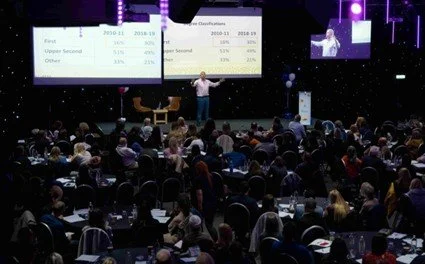
1. Talks, workshops and seminars - I am an award-winning speaker. My talks include recruiting and retaining Gen Z, understanding Gen Z, overcoming the challenges of the multigenerational workplace plus those relevant to the topics below. Speaker showreel here.
2. My book The Snowflake Myth is out now - to receive a free chapter please click here.
3. One to one coaching programmes for senior leaders who are swamped by their jobs so they can thrive in life.
4. Team coaching programmes - working IN a team is not the same as working AS a team and yet they are often treated as if they are the same. I help teams move from the former to the latter, and generate huge shifts in productivity and outcomes.