What causes conflict between Gen Z and older managers?
Here is an uncomfortable conversation happening in organisations across the UK.
On one side of the table sits an older manager who has spent decades building their expertise and earning their authority.
On the other side sits a Gen Z employee in their early to mid-twenties, asking for feedback they have not yet received, questioning a process they do not understand and requesting not to attend a meeting they believe could have been an email.
Neither side is wrong.
But both sides are frustrated.
Somewhere in between, productivity, retention and workplace morale takes the hit.
If you are the manager how do you handle this?
If you are thinking ‘do I have to?’...my answer is I’m afraid so. But don’t worry that this starts with concession after concession from you, and it’s definitely doesn’t mean you need to dilute your expectations around quality.
TL;DR
Conflict between Gen Z and older managers is one of the most common workplace challenges facing UK organisations. The causes are specific: a feedback frequency gap, clashing attitudes toward authority and hierarchy, poor line management that disproportionately affects Gen Z, different communication styles and mismatched expectations around career progression and work-life balance. None of these are insurmountable. Gen Z's characteristics make them highly responsive to managers who adapt their approach. This post covers what causes the conflict and the practical steps that resolve it.
1.Start by finding the fault lines
You aren’t alone.
According to research explored in my book The Snowflake Myth, a 2024 survey found that 45% of hiring managers consider Gen Z the hardest generation to work with.
That’s more than five times as difficult to manage as Baby Boomers and more than three times as difficult as Gen X.
Meanwhile, Gen Z is not exactly queuing up to praise their line managers either. The same generation that wants more feedback, more transparency and more purpose in their working lives is finding that the structures and styles they report into were not designed with any of those things in mind.
It is a collision of two perfectly sets of expectations built in entirely different eras, shaped by very different experiences and expressed in ways that can feel like a personal affront to the other party.
The manager who interprets a Gen Z employee's directness as disrespect. The Gen Z employee who reads a lack of regular feedback as indifference, or worse, hostility.
The good news is that this is a solvable problem. It just requires both sides to understand what they are actually dealing with.
That starts with knowing where the fault lines are, and in this you the older manager has an advantage.
Your life experience means that you can compare your early professional life to theirs in a way that they cannot. You are able, if you take a little time, to try and see the world through their eyes more easily than they can do the same.
2.The feedback frequency gap
Ask a Gen Z employee what they want from their manager and feedback will be near the top of the list (and not the annual appraisal kind).
This is a generation that has grown up in an environment saturated with real-time data.
Social media, online learning platforms and gaming all provide continuous loops of information about performance and progress.
To arrive in a workplace where the answer to ‘how am I doing?’ is ‘we’ll discuss it in December’ can feel genuinely disorienting.
The contrast between how Gen Z has been conditioned to receive feedback and how most organisations currently deliver it is stark, as I explore in The Snowflake Myth.
The young employee who stops a manager in the corridor to ask how they could improve is not being impatient or needy. It is a Gen Z characteristic because they are doing exactly what their educational experience has trained them to do. The Gen X manager who tells them to wait for their appraisal is not being obstructive, they are operating from a model that they grew up with.
The fix is not complicated, though it does require commitment.
Shorter, more frequent performance conversations that do not require formal extended meetings or lengthy preparation make a significant difference. You are looking for one impactful, bite-sized chunk after another.
A brief check-in after a presentation, a note on a report, five minutes at the end of the week. Organisations that make this the norm report stronger Gen Z engagement, lower turnover and managers who feel less like they are carrying the weight of the whole relationship alone.
3.Authority and hierarchy
One of the most consistent themes in my work as a generations speaker is the reaction older managers have when Gen Z employees question the way things are done.
‘We’ve always done it this way’ has never been a particularly persuasive argument, but for Gen Z it is almost guaranteed to produce the opposite of the intended effect.
This is a generation that has grown up with declining trust in institutions. Governments, banks, media organisations and large corporations have all experienced significant credibility deficits in the years that shaped Gen Z’s world view.
As I explore in The Snowflake Myth, asking Gen Z to simply defer to authority without explanation is asking them to act against every instinct they have developed.
What it means in practice is that authority needs to be earned rather than assumed. A manager who explains their rationale, even briefly, will get a very different response from one who simply issues instructions. Where possible, connect it to the purpose of the organisation.
You don’t have to be right, but you do have to explain why.
Increasingly this is not unique to Gen Z. The difference is that Gen Z will push back where an older employee might have stayed silent, and that pushback can feel confrontational to managers who were not expecting it.
Build the habit of brief explanations alongside instructions. “Here is what I need and here is why” takes thirty seconds and reduces the friction.
4.High quality line management
Organisations and their leaders can be reluctant to discuss how they do line management.
I know from my work as a leadership team coach that it barely comes up at all.
A lot of friction between Gen Z and older managers does not come from generational differences, but from poor line management which amplifies it.
I’m referring to line management meetings being cancelled without notice or reason, minimal preparation, one to ones becoming a ‘one’ and managers who are only available at formal meetings while ignoring every message in between.
These are not Gen Z problems. They are management problems. They would erode any employee’s engagement. What is different with Gen Z is that disengagement is faster, more visible and more likely to result in departure.
The CIPD’s Good Work Index consistently identifies management quality as a primary driver of employee wellbeing and retention across all generations, but its impact on Gen Z is acute.
The multigenerational workplace gives organisations a useful mirror. If your Gen Z employees are disengaging at speed while older employees seem compliant, then I query why you would equate compliance with engagement.
The line manager who works well with Gen Z tends to be the one who is a good manager to anyone else. They are available, clear, honest and genuinely interested in the development of the people they are responsible for.
Remember that
The clash between Gen Z and older managers is about two sets of expectations, formed in very different environments who meet without a shared framework. Start by naming that explicitly, and half the work is done.
Gen Z’s request for regular feedback is not impatience. It is a reflection of a generation conditioned by real-time data loops, from social media to online learning. The annual appraisal was never designed for them and will not retain them either.
Questioning authority is not disrespect. It is what happens when a generation raised on declining institutional trust arrives in structures that still expect deference. Explanation beats instruction almost every time.
The multigenerational workplace is an opportunity as much as a challenge. Organisations that actively leverage age diversity — particularly through structured reverse mentoring — consistently build more resilient, more innovative teams than those that merely tolerate generational difference.
FAQ
1. Why do Gen Z and older managers clash?
Gen Z and older managers typically clash because of mismatched expectations around feedback, communication, authority and work-life balance. These differences are rooted in the different environments each generation grew up in rather than bad intentions on either side. Understanding those roots is the first step to resolving the tension.
2. Is Gen Z really harder to manage than other generations?
A 2024 survey found that 45% of hiring managers consider Gen Z the hardest generation to work with. However, this perception often reflects a gap in management approach rather than a fundamental problem with Gen Z. Managers who adapt their feedback style, communication methods and approach to authority tend to find Gen Z highly engaged and motivated.
3. How can managers give Gen Z better feedback?
The key is frequency and informality. Rather than relying on annual appraisals, effective managers create regular, low-stakes feedback moments — brief conversations, notes on work or a quick check-in at the end of a project. Gen Z has grown up with real-time feedback loops and finds the once-a-year model genuinely difficult to work within.
4. What is reverse mentoring and does it work?
Reverse mentoring involves younger employees sharing their knowledge and perspective with more experienced colleagues rather than the traditional model where wisdom flows only in one direction. When structured well and approached with genuine openness on both sides, it consistently produces stronger cross-generational relationships and faster learning across the team.
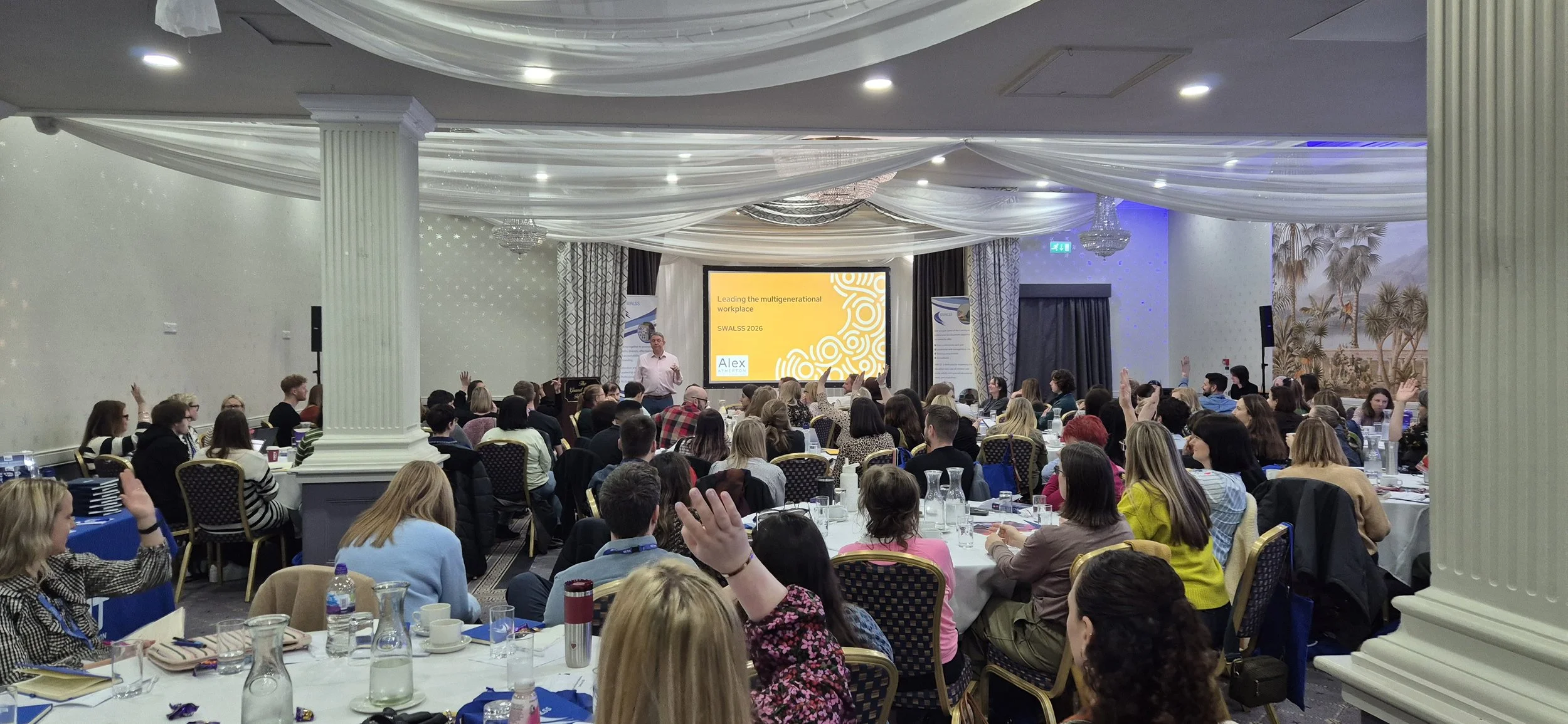
Alex Atherton is an award-winning Gen Z speaker and generations expert who helps organisations navigate multigenerational workplace challenges. Author of The Snowflake Myth, he specialises in Gen Z recruitment and retention, and leadership development.
How can I help you?
1. Talks, workshops and seminars - I am an award-winning speaker. My talks include recruiting and retaining Gen Z, understanding Gen Z, overcoming the challenges of the multigenerational workplace plus those relevant to the topics below. Speaker showreel here.
2. My book The Snowflake Myth is out now - to receive a free chapter please click here.
3. One to one coaching programmes for senior leaders who are swamped by their jobs so they can thrive in life. Click here to discover where you are on your journey from Frantic to Fulfilled? Just 5 minutes of your time and you will receive a full personalised report with guidance on your next steps.
4. Team coaching programmes - working IN a team is not the same as working AS a team and yet they are often treated as if they are the same. I help teams move from the former to the latter, and generate huge shifts in productivity and outcomes.