Gen Z Talent Strategies for UK Employers in 2026
Are you losing Gen Z talent to competitors who better understand their priorities?
If this was happening in 2025 the chances are it will only get worse in 2026.
Employers are increasingly waking up to the fact that both recruitment and retention have to be done differently with Generation Z.
With the Gen Z workforce approaching 30% of UK employees and the multigenerational workplace becoming the norm, organisations must adapt their Gen Z recruitment strategies and talent retention approaches.
The key question now is 'how' not 'whether'.
That means that the strategies used by your competitors to recruit your best young staff, who you have spent time and money on developing, will only get better.
And if, big if, the job market and economy recovers the problem will only be amplified.
2026 is the time to get a little more sophisticated about your talent strategies.
Here's four strategies to consider.
TL;DR
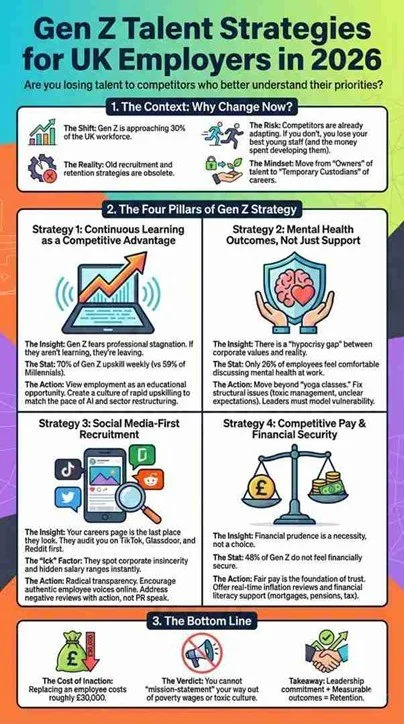
UK employers must adapt four Gen Z talent strategies for 2026: treat continuous learning as competitive advantage (70% upskill weekly), deliver mental health outcomes not just support (only 26% comfortable discussing wellbeing), prioritise social media-first recruitment (they audit you on LinkedIn/Glassdoor/TikTok before applying) and provide competitive pay addressing financial insecurity (48% feel unstable). With replacement costs at £30,000 per employee and Gen Z nearing 30% of workforce, organisations must become temporary custodians of careers, not owners. Requires leadership commitment and measurable outcomes, not token gestures.
1. Continuous learning and upskilling is your competitive advantage for the Gen Z workforce
Gen Z is acutely aware that the skills they acquired during their education are decaying rapidly.
The same applies to everything you learned when the world stopped during the pandemic.
Old news. Out of touch. Yawn.
Yet the organisations who used the pandemic as the catalyst for a revolution in their learning culture are best placed now.
And Gen Z is becoming aware (often painfully) that the first class degree with the outrageous level of debt has not led to the employment opportunities they expected.
The organisation who continuously adds value to their employees are also the most attractive both to join and to stay.
This isn’t just one way traffic, it also helps employees add value to you. Gen Z understands how rapidly the world is changing and would rather work for an agile organisation that anticipates and acts upon it.
They've watched AI accelerate, job roles transform and entire sectors restructure. They know that standing still professionally means moving backwards in a marketplace that rewards adaptability.
Consequently, they view employment as an educational opportunity as well as a financial transaction. If they're not learning, they're leaving.
The statistics support this self-directed approach to development. Research from Spencer Clarke Group shows that 70% of Gen Z accountants develop skills weekly, compared to 59% of millennials.
The organisations that will attract and retain Gen Z talent are those that recognise a fundamental truth: you don't own your employees' careers.
You're temporary custodians of their professional development.
If you try to hoard talent by limiting their growth, they'll find organisations that won't.
2. Prioritise Mental Health and Wellbeing outcomes, not just support
There's a troubling disconnect in UK workplaces.
Many organisations have added mental health language to their values statements, appointed wellbeing champions, and subscribed to employee assistance programmes.
Yet only 26% of employees feel comfortable discussing mental health at work, according to recent Workplace Journal research.
This gap isn't just disappointing; it's actively harmful.
Gen Z are facing unprecedented levels of anxiety, burnout and mental health challenges. Whether your managers understand this, or even care about it, is not the biggest issue in 2026.
The biggest issue is whether your top table is committed to
Finding out what percentage of your employees do feel comfortable talking about mental health in your organisation.
Determining how you can close the gap.
You will never get to 100%; you will always have colleagues who would rather not talk about their health per se.
But when Gen Z encounters workplaces that claim to care about wellbeing but create cultures where vulnerability is punished, where stress is worn as a badge of honour and where admitting struggle is seen as weakness they recognise the hypocrisy immediately. They won't stay.
Effective mental health support in 2026 requires several interconnected elements.
First, trained mental health first aiders who are visible, accessible, and empowered to make referrals without requiring line manager approval.
Second, robust EAPs that employees actually use because they trust confidentiality and believe the support will be helpful.
Third, leaders who model vulnerability by discussing their own mental health challenges and setting boundaries around working hours and availability.
Most critically, it requires acknowledging that many mental health issues in the workplace are caused by the workplace itself.
Excessive workloads, unclear expectations, toxic management, lack of autonomy and constant availability demands aren't just stressful; they're structurally damaging.
You cannot wellbeing-initiative your way out of a fundamentally unhealthy work environment.
Gen Z understands this. They're not looking for yoga classes. They're looking for organisational structures that don't make them ill.
3. Social Media first recruitment strategy
Your corporate careers page is no longer the first touchpoint in the Gen Z recruitment journey.
For Gen Z, it's often the last place they look, and only after they've conducted extensive due diligence through social channels.
They're auditing your organisation on LinkedIn, scrutinising your employee reviews on Glassdoor, watching your junior staff on TikTok and discussing your reputation on Reddit threads you don't even know exist.
They're assessing whether your organisation's stated values match the authentic employee experience and workplace culture described by current and former employees.
By the time they consider applying, they've already formed strong opinions about your culture and what matters to them.
Gen Z are heavily focused on work-life balance indicators in reviews. They're looking for transparency about salary ranges and career progression pathways. They're assessing whether your organisation's stated values match the lived experiences described by current and former employees.
They're specifically alert to the ‘icks’ of corporate insincerity, toxic management or cultural dysfunction that make an organisation instantly unappealing.
Effective recruitment in 2026 requires an awareness and control of your digital footprint whilst accepting you cannot control the narrative entirely.
This means ensuring salary ranges are transparent in job postings, not hidden behind ‘competitive package’ vagueness.
It means encouraging your early-career employees to share authentic experiences on social platforms rather than trying to suppress or sanitise employee voice. It means responding to negative reviews with specific actions taken to address issues rather than defensive corporate-speak.
The organisations succeeding with Gen Z recruitment are those that recognise the power has shifted.
You're being evaluated by discerning consumers who have extensive information and the very best have multiple options. Your recruitment process needs to reflect that reality through transparency, respect for candidates' time and alignment between what you promise and what you deliver.
In 2026 you should carry out your own digital due diligence. Better still get a young employee to take you on the journey of how they would do it. It will raise your eyebrows, make you squirm even but you need to see it through.
4. Deliver competitive pay and benefits that address real insecurity
The cost of living crisis has left deep scars on Gen Z.
They've watched housing become increasingly unaffordable, seen their millennial predecessors crushed by student debt and stagnant wages and recognised that the economic contract offered to previous generations has been withdrawn.
They're financially prudent not by choice but by necessity.
It is not impossible to inspire creativity and commitment from people who are worried about making rent, but it doesn’t help either.
The statistics are stark. Research from Deloitte shows that 48% of Gen Z and 46% of millennials do not feel financially secure. This isn't about entitlement or unrealistic expectations. It's about the mathematical reality that salaries haven't kept pace with housing costs, that entry-level positions don't provide enough income to save meaningfully and that economic instability has become normalised.
Effective pay strategies in 2026 require several elements.
First, regular salary reviews that account for real-time inflation rather than annual benchmarking exercises that lag behind the cost of living.
Second, financial literacy support through workshops covering pensions, mortgages, investing and tax efficiency.
Third, meaningful benefits that reduce immediate costs such as subsidised transport, meal provision, or housing support schemes.
The daily email job alerts your young employees receive will show them the employers who are offering a better deal.
The organisations attracting Gen Z talent are those that recognise fair pay is the foundation of trust. Without it, every other retention initiative rings hollow. You cannot mission-statement or wellbeing-initiative your way past poverty wages.
Gen Z are not asking to be overpaid. They're asking to be paid enough to live without constant anxiety. That's not an unreasonable demand. It's a minimum standard for dignified employment.
Remember That
Flexibility means autonomy over outcomes, not location—Gen Z wants to be judged on results rather than presence, requiring outcome-focused management that trusts employees to structure work around their lives.
Purpose requires operational alignment, not marketing statements—Gen Z aren't asking for perfection, but they will leave organisations whose stated values contradict actual practices, particularly regarding environmental and social issues.
Frequently Asked Questions
How much will Gen Z turnover cost UK employers in 2026?
Replacing a Gen Z employee costs approximately £30,000 on average, according to CIPD data, when accounting for recruitment expenses, onboarding time and lost productivity during the vacancy period. Organisations without targeted retention strategies can expect 20-30% higher churn rates. For a 100-person organisation, this translates to £600,000-£900,000 in annual turnover costs. The ROI on implementing proper talent strategies becomes clear when compared against these replacement expenses.
What free tools can UK employers use for Gen Z recruitment on social media?
LinkedIn's free job posting feature now supports salary transparency requirements and reaches 30 million UK users. TikTok's organic video content costs nothing and allows employee storytelling that reaches Gen Z authentically. Canva provides free templates for creating visually appealing recruitment content. Glassdoor's employer account allows responding to reviews and showcasing company culture. Buffer's free tier manages posting across multiple platforms. Google Analytics tracks which channels drive applications. The key isn't expensive tools but authentic employee voice and transparent information that align your digital footprint with workplace reality.
How do UK laws support flexible working for Gen Z in 2026?
The Employment Relations (Flexible Working) Act 2023 entitles all employees to request flexible working from their first day of employment, a significant expansion from the previous 26-week waiting period. Employers must respond within two months and can only refuse requests based on eight specific business grounds: burden of additional costs, detrimental effect on ability to meet customer demand, inability to reorganise work among existing staff, inability to recruit additional staff, detrimental impact on quality or performance, insufficiency of work during proposed periods, or planned structural changes. This legal framework makes schedule autonomy increasingly enforceable, requiring organisations to justify inflexibility rather than employees justifying flexibility.
Alex Atherton is an award-winning Gen Z speaker and generations expert who helps organisations navigate multigenerational workplace challenges. Author of The Snowflake Myth, he specialises in Gen Z recruitment and retention, and leadership development.
How can I help you?
1. Talks, workshops and seminars - I am an award-winning speaker. My talks include recruiting and retaining Gen Z, understanding Gen Z, overcoming the challenges of the multigenerational workplace plus those relevant to the topics below. Speaker showreel here.
2. My book The Snowflake Myth is out now - to receive a free chapter please click here.
3. One to one coaching programmes for senior leaders who are swamped by their jobs so they can thrive in life. Click here to discover where you are on your journey from Frantic to Fulfilled? Just 5 minutes of your time and you will receive a full personalised report with guidance on your next steps.
4. Team coaching programmes - working IN a team is not the same as working AS a team and yet they are often treated as if they are the same. I help teams move from the former to the latter, and generate huge shifts in productivity and outcomes.