It's the managers, stupid.
The vision is in place, the senior leaders are aligned and the messaging is clear.
Let’s do this!
What could go wrong?
In truth, everything.
Gallup’s recent report on employee engagement showed many problems, not least the $10 trillion of lost productivity annually across the world.
Less attention has been paid to manager-specific data.
‘Manager engagement’ dropped nine percentage points between 2022 and 2025, with the steepest single-year fall occurring between 2024 and 2025 — from 27% to 22%.
The gap between manager engagement and everyone else is a mere 3%.
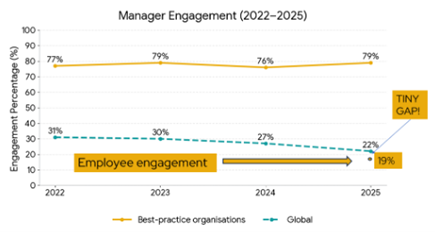
This is engagement OF managers not engagement WITH managers. And by engaged, Gallup means those who are ‘actively involved and enthusiastic’. It’s a high bar but it’s not unreasonable either, particularly given the chasm between the average and the ‘best-practice organisations.
In a multigenerational workplace already navigating generational differences, technological transformation and shifting expectations this is not background noise.
The answer to the ‘what could go wrong’ question above is more frequently the manager.
What can you do?
Here are five aspects to consider.
TL;DR
Gallup's 2026 data shows manager engagement has fallen sharply, and it's dragging everything else with it. AI investments are failing. Gen Z are leaving. Succession pipelines are emptying. The cause isn't the technology, the strategy or the generation. It's the manager. And critically, it's resolvable. Organisations with engaged managers consistently outperform those without.
1. The engagement premium has gone
First things first I want to clarify the difference between this blog and a recent one on line managers. That focused on what could be done WITH managers, this is about what can be done FOR them.
Managers used to enjoy higher engagement than the people they managed. More autonomy, variety and sense of impact all added up to something substantial.
Gallup's data shows that premium has effectively collapsed. The broader workforce has barely moved, although remains low. It is possible that in a year’s time the managers will be below those they manage.
This matters because the manager is not just another employee. Gallup's own research consistently shows that the manager or team leader accounts for 70% (yes SEVENTY) of the variance in team-level engagement.
A disengaged manager does not simply underperform in isolation, they create the conditions for their entire team to underperform.
Understanding generational differences in the workplace is useful, but it is academic if the person leading the team has checked out. Fix the manager engagement crisis, and a significant proportion of the broader engagement crisis resolves alongside it.
Within your organisation you need to know the size of your own gap. What are engagement levels amongst your managers and everyone else? And how do you know?
2. AI investment is failing (so far)
The ‘AI problem’ is pretty much common knowledge now. In short, organisations have collectively invested many billions into AI and the returns have been low or non-existent.
An NBER survey of nearly 6,000 global executives found 89% reporting no impact on labour productivity. Only 12% of employees in AI-implementing organisations ‘strongly agree’ that AI has transformed how work gets done.
According to Gallup employees who ‘strongly agree’ their manager actively supports AI use are 98.7 times as likely to strongly agree that AI has transformed how they work.
Not 98.7% more likely, or ten times better but almost ONE HUNDRED TIMES more likely.
Those same employees are 97.4 times as likely to say AI gives them ‘more opportunity to do their best work’.
It’s no-brainer territory and of course the bosses have invested for the change to happen. But if the manager isn’t into it, it falls apart.
The technology is not the barrier. The manager is. If their levels of engagement are low then they aren’t changing.
I’m going to use unhelpful stereotypes to make a point. Gen Z are often more open to AI experimentation, but they look to their manager for permission and encouragement before committing to it. Gen X and Boomers carry higher anxiety and need explicit reassurance from the manager.
Without manager engagement and support there is no catalyst for change.
3. Separate the data
I’ve hammered the point that managers really matter enough. Let’s focus on what you can do differently.
First, if you measure employee engagement as a single number, without a breakdown by staff group, then the problem can be invisible precisely when it most needs attention.
Tracking manager engagement as a distinct metric changes what you can see and therefore what you can act on. It allows organisations to identify whether a retention problem sits in a specific team, a specific function or a specific layer of management. It allows HR and senior leadership to spot declining manager engagement before it cascades into team-level disengagement. As Gallup's data confirms, that cascade is both predictable and significant.
4. Focus on manager recognition and voice
In theory managers are the people who recognise everyone else. They deliver the praise, have the conversations about career development, notice when someone is struggling and acknowledge when a team has performed well.
How much of that recognition flows back to them.
This is not simply an oversight. It reflects a broader assumption that managers, having reached a position of seniority, no longer need the same validation and acknowledgement that their teams do. Gallup's data suggests this assumption is badly wrong. The emotional toll of leadership is in part a recognition deficit problem. Managers are operating in a one-way system where they are expected to give what they are not receiving.
Fixing this requires deliberate design, not goodwill. Senior leaders need to build explicit upward recognition into their own practice, not as a soft HR initiative but as a structural expectation. Conversations that specifically ask managers how they are finding the role, what support they need and what they feel is going well create a feedback loop that currently does not exist everywhere.
In a multigenerational workplace where the manager is already navigating competing generational expectations, being recognised for that navigation (rather than simply held accountable for its outcomes) makes a material difference to whether they stay engaged or quietly stop trying.
Just in case you are thinking that this topic does not have a generational perspective to it, remember that two thirds of Gen Z see managing others as ‘too high stress, low reward’. That is simply a comment on what they witness in their own workplace.
As engagement falls, your manager pipeline falls with it. Low manager engagement is not a good advertisement for the role.
5. Redefine the role
Last but definitely not least, the big structural issue.
Ask a manager hired five years ago what their job description said, then ask them what they actually did yesterday. The gap between those two answers is part of the engagement crisis that Gallup's data is capturing.
The manager role has expanded enormously without a corresponding expansion in support, training or accountability adjustment.
Expectations of managers have shifted considerably post COVID. It always was a challenging role with the risk of being part of the ‘squeezed middle’.
They are now routinely expected to be performance coaches, DEI champions, mental health first responders, AI adoption leads, hybrid work coordinators and talent development specialists. And that’s simultaneously, often without briefing let alone training, and always in addition to the functional responsibilities they were actually hired for.
The result can be a role which is genuinely impossible to do well, that means managers default to doing the parts they are most comfortable with and quietly abandoning the rest.
‘Hanging in there’ is not a strategy, and those they manage have worked that out.
Redefining the role means conducting an honest audit of what managers are being asked to carry and making deliberate decisions about what belongs there.
Some responsibilities can be redistributed. Some can be supported by a specialist, for example a mental health first aider at team level rather than the manager acting as an untrained proxy. Some expectations need to be explicitly dropped. The organisations achieving 79% manager engagement in Gallup's best-practice data are not asking their managers to do more. They are asking them to do a clearer, better-supported version of less.
Remember that
Manager engagement has fallen nine percentage points since 2022 and is now the primary driver of the overall global engagement decline. Fixing the workforce engagement crisis requires fixing the manager engagement crisis first.
The 98.7x difference in AI transformation outcomes depending on manager support is not a rounding error, it is the explanation for why most AI investment has produced no measurable return (yet).
Gen Z's reluctance to aspire to leadership is not a character flaw. It is a rational response to watching disengaged managers model what the job actually looks like. They don’t want to be them.
Best-practice organisations achieve 79% manager engagement. This is a solvable problem, not a structural inevitability. Having said that it would be much better if Gallup had said WHO is getting that level of engagement.
FAQ
1. Is this just a UK and US problem or is it global? Global, and that is part of what makes the Gallup data so striking. The 20% engagement figure spans every region surveyed, and not a single region saw an improvement in 2025. The manager engagement collapse is not a cultural quirk of one labour market, it is happening across industries, geographies and organisation types simultaneously. If anything, that makes it harder to dismiss as someone else's problem. Again I’d prefer it if Gallup had given examples of the high performing companies.
2. We already run an annual engagement survey. Isn't that enough? It depends entirely on whether you segment the results by role type. A single aggregate score tells you very little. If your managers are at 22% engagement and your individual contributors are at 19%, those numbers average out to something that looks unremarkable, and the manager crisis stays invisible. The survey is only useful if it is designed to surface the right distinctions.
3. Can one good senior leader compensate for a disengaged manager layer? Not at scale. A brilliant CEO or HRD can create cultural conditions and set expectations, but the Gallup data is clear that 70% of team-level engagement variance sits with the direct manager. Senior leaders operate too far from the daily experience of most employees to compensate for what is — or is not — happening at team level. Inspiration from the top matters. It does not substitute for the manager in the room.
4. Where do you even start if the problem is this widespread? With the data, then the role. Find out what your manager engagement actually looks like, separately from everything else. Then ask your managers, in a format where they can be honest, what the job actually requires of them day to day versus what they were supported to do. The gap between those two answers is where the intervention needs to begin. It is rarely glamorous work, but it is almost always more revealing than another leadership away day.
Alex Atherton is an award-winning Gen Z speaker and generations expert who helps organisations navigate multigenerational workplace challenges. Author of The Snowflake Myth, he specialises in Gen Z recruitment and retention and leadership development.
How can I help you?
Talks, workshops and seminars — I am an award-winning speaker. My talks include recruiting and retaining Gen Z, understanding Gen Z, overcoming the challenges of the multigenerational workplace plus those relevant to the topics below. Speaker showreel here.
My book The Snowflake Myth is out now — to receive a free chapter please click here.
One to one coaching programmes for senior leaders who are swamped by their jobs so they can thrive in life. Click here to discover where you are on your journey from Frantic to Fulfilled? Just 5 minutes of your time and you will receive a full personalised report with guidance on your next steps.
Team coaching programmes — working IN a team is not the same as working AS a team and yet they are often treated as if they are the same. I help teams move from the former to the latter and generate huge shifts in productivity and outcomes.