
The benefits argument will continue.
But at almost 120,000 words it takes a little digging to find the parts of the Milburn report that will change your job.
-
Alan Milburn's final report on young people and work contains a string of proposals that
would land on employers and schools, from scoring youth hiring on public contracts to Ofsted inspecting whether pupils are ready for work. The government has accepted (so far) a locally run system and supports the two youth guarantees. Everything else waits for a White Paper in the new year. My view: most of these 10 are worth getting ready for anyway. And the one thing the report barely mentions, the line manager, is the thing that decides whether any of it works. This piece covers employers, schools and colleges.
It may have been a wall of media on launch day but that can only go so far with a 278 page report (and a 40 page executive summary).
Ultimately a report is just a milestone. The government response will follow, then a White Paper and legislation. Even with Royal Assent it can take some time for all that is in law to become reality.
But you can start to prepare now.
The aspects to consider is a longer list this week and organised by category.
And yes I’ve used AI for the referencing but all in a bid to be useful.
1. Older staff funded by the apprenticeship levy will cost more (Employers)
What Milburn recommends: under-25 apprenticeships 100% funded from levy proceeds for every employer, whatever its size. Government funding for apprentices aged 25 and over would fall by 25% (para 470).
Why it matters if you work in L&D: plenty of employers use the levy to upskill existing staff, from management qualifications to degree apprenticeships. It is a separate change from the existing rule that employers co-invest 25% once their levy funds run out.
What you can do now: pull last year's levy spend and split it by apprentice age. If most of it went on over-25s, model what a 25% cut and a 50% cut would cost you.
2. Your visa sponsorship could depend on trying young people first (Employers)
What Milburn recommends: in sectors with large entry-level workforces and high youth detachment, government ‘should examine the scope’ for linking access to work visas to evidence that employers have ‘made serious efforts’ to recruit young people, especially those who are NEET. The mechanism should be tested against the risk of creating labour shortages (final report, Chapter 3). Status: recommended for examination only.
Why it matters if you sponsor workers: this is the most tentative proposal on the list but potentially one with the sharpest edge. The interim report said too many employers had been on ‘easy street’, sourcing labour overseas while ignoring supply closer to home (interim para 283). Hospitality, care, logistics and food production might feel this first.
What you can do now: start keeping a record of how you advertise entry-level roles locally, how many young applicants you get and what happens to them. If the rule ever arrives, the employers with two years of evidence will be in a far better place than those starting from scratch.
3. Long-term sickness absence for under-25s could move out of the GP surgery (Employers)
What Milburn recommends: responsibility for long-term sickness absence moves out of general practice into the new Youth Opportunity Service, building on the Community Work and Health Teams already being trialled. Clinical care stays with the GP. An under-25 making a health-related benefit claim would automatically trigger an offer of support (para 88). Proposed start: 2027 (para 147).
Why it matters if you manage absence: the interim report called the fit note the "poster child" of structural failure: about 11 million a year in England, 93% of them marked "not fit" (interim para 468). Milburn wants a fit note to become the start of a support process, not a certificate of absence. For HR, that means a new party in absence cases for young staff, and very possibly a much more useful one than you have now.
What you can do now: look at last year's long-term absence cases for under-25s. How many had a phased return plan in the first month? How many included a conversation with their manager about what they could do, rather than what they couldn't? At least examine the possibilities and potential impact for you.
4. A small firm could get up to £7,000 for one hire (Employers)
What Milburn recommends: £3,000 for employers taking on any young person who has been NEET for six months; £2,000 more where the young person faces substantially greater barriers, such as care leavers or disabled young people; and a further £2,000 for businesses with fewer than 50 staff. The apprenticeship hiring payment rises to £2,500 and extends to levy payers (para 51).
Why it matters if you run or advise a small business: today's £3,000 Youth Jobs Grant covers only eligible 18 to 24 year-olds after six months on Universal Credit (para 255). The new version would include the 314,000 hidden NEETs who claim nothing (para 51). The full £7,000 applies only when all three conditions are met. The package is worth about £1.1bn a year and aims at 170,000 extra opportunities (para 52).
What you can do now: work out which of your roles could take someone with no work history, and what their manager would need to make that work.
5. Risk of NEET tracking would start in primary school (Schools)
What Milburn recommends: Risk of NEET Indicator (RONI) tools become mandatory in both primary and secondary schools, to identify and support pupils at risk of becoming NEET (para 61).
Why it matters if you lead a school: children who are not school-ready at four or five are nearly three times as likely to be NEET at 16 or 17 (interim para 302). It’s hard to dispute the logic. The risk is a label that follows an eight year-old around for a decade, interesting one to chew over at SLT. A RONI score is only as useful as what the school does next. The interesting bit is handing over that information at transition to secondary, assuming that would be an expectation.
What you can do now: primary heads, ask your local authority whether it already runs a RONI tool for secondaries and which indicators it uses.
6. Ofsted would inspect whether pupils are ready for work (Schools)
What Milburn recommends: a new Ready-for-Work Standard showing whether young people leave school with the foundations, experience and confidence for the next stage, with school-level data published and inspected by Ofsted. Alongside it, a new outcome measure judging schools on where students end up (para 66). Proposed for 2028 (para 148).
Why it matters if you lead a school: judging schools on destinations as well as results is long overdue in my view. It’s also much easier said than done, and I’m concerned about the potential side effects of this, including schools taking on hard to place kids. At the moment Ofsted does not report on whether young people end up in sustained employment or learning (interim para 360).But if the destinations count starts at 16, a school can improve its figures by losing a pupil before then (or never admitting in the first place). That's my worry, rather than the report's, and the lack of activity on the new Admissions Code is not helping..
What you can do now: not easy actually. Senior leaders can look at everyone who currently counts as NEET in your published data. Does that info just sit with a single nominated member of staff.
7. A new key stage 3 check, and 10% of the timetable ‘back in your hands; (Schools)
What Milburn recommends: a statutory key stage 3 check in writing, numeracy and oracy, with schools given discretion over around 10% of curriculum time.
Why it matters to schools and employers: I expect the education professional organisations to fight this, and drag their heels in making it happen. Feels an easy one to forget about down the line. A return to a version of key stage 3 SATs will not be popular. Only 3% of employers hiring 16 year-olds cite poor literacy or numeracy, against experience, confidence and readiness (interim para 253). But 81% of NEET young people surveyed said the curriculum is too focused on passing exams (interim para 119). Around 10% of a 25-hour week is two and a half hours. It feels messy and Becky Francis’ work is ongoing.
What you can do now: at least know what is proposed, but in general - wait.
8. Every at-risk pupil would need a transition plan, excluded pupils included (Schools)
What Milburn recommends: as part of tackling exclusions, every pupil at risk would have a transition and participation plan (para 61), with the Youth Opportunity Service picking young people up when they fall out of education (para 104). Status: recommended.
Why it matters if you lead a school or a trust: depends on the number of suspensions you have and how many of them have SEN support or an EHCP (interim para 333). Pupils who are excluded, moved on or moved to alternative provision can be the ones whose records go missing (not least because moving anywhere makes that more likely). He didn’t mention the explosion in those home-schooling, a really big miss in my view, but a new Admissions Code is due to follow now that the Children and Wellbeing Act has Royal Assent.
What you can do now: how tight are your records for where your former pupils have gone to before they were due to leave anyway? How many of them have the basis of a transition plan on your existing records?
9. Work experience would become a legal duty on schools (Both employers and schools)
What Milburn recommends: work experience becomes a statutory duty on schools, and careers education joins the new Youth Opportunity Service (para 65). Practical barriers to work experience are removed in 2027 (para 147).
Why it matters to both: the duty falls on schools, but the placements come from employers. Lack of work experience is the single most-cited barrier to work among young people, and the share of 16 and 17 year-old students doing any paid work fell from 35% in 2006 to 19% (interim paras 355 and 233). Only 39% of NEET young people had work experience at secondary school, against 56% of their peers (FE News on the final report). I’ve seen lower version of that measure.
What you can do now: I could say a lot but I recommend both get ready to input on what the Youth Opportunity Service looks like. But be ready to contribute too, this will be a significant shift in some areas.
10. The NHS would be judged on NEET rates, and employers would get one front door to call (Both)
What Milburn recommends: cutting NEET rates becomes a formal objective and a legal requirement for every NHS Integrated Care Board (para 89). National maximum waiting times for young people's mental health care by 2028 (para 86). And the Youth Opportunity Service becomes a single front door for employers who want to hire young people, offer work experience and support them while in work (para 53).
Why it matters to both: 44% of NEET young people report a work-limiting health condition, up from 26% in 2015 (interim report). The final report admits that line managers are left to work out for themselves which part of the State to call when a young recruit starts to struggle. One front door would fix that. For schools, it is the same door pupils at risk get passed through.
What you can do now: find out who runs your local youth hub or Youth Guarantee trailblazer. They are likely to be the core of the new service. Put the contact in your manager handbook and on your pastoral team's list.
What the Milburn report barely mentions: managing Gen Z in the workplace
In 278 pages, the phrase "line managers" appears twice. Both times they are described as carrying the burden: inheriting young recruits with less familiarity with the workplace, and being left to work out which part of the State to call when things go wrong. Manager training appears once, inside a case study.
That matters for managing Gen Z in the workplace. The interim report found one large employer had hired a full-time social worker to support its younger staff, and said employers "are not clinical services" (interim para 259). Grants, guarantees and front doors are useful. A £3,000 grant gets a young person through the door. A trained manager keeps them there.
Much more to follow on this one.
FAQ
Is the Milburn review law?
No. Milburn's final report is a set of recommendations. On 17 November 2026 the government accepted a locally delivered system and supported the Opportunity and Support Guarantees, then said it would consider the rest alongside the Timms review. A White Paper is due in the new year, followed by legislation.What does the Milburn review mean for employers?
If adopted, it means cheaper and subsidised first hires, scored youth hiring on public contracts and a single local service to call for help. The incentive package is worth about £1.1bn a year, according to the final report. It says almost nothing about the line managers who will receive these recruits.What does the Milburn review mean for schools?
Schools would face mandatory Risk of NEET tools in primary and secondary, a statutory key stage 3 check including oracy, a legal duty to provide work experience and Ofsted inspection of a Ready-for-Work Standard, proposed for 2028. Schools would also be judged on where pupils end up, not only on results.
Sources
Milburn, From a Welfare State to a Working State, final report, DWP, 17 November 2026 (gov.uk URL to add: I could not find the publication page): every para reference without "interim"; 278 pages; under-25 apprenticeship starts 172,000 to 270,000; £1.1bn incentive package and 170,000 opportunities; 314,000 hidden NEETs; "line managers" twice
DWP, Work and Pensions Secretary statement on the Milburn review, 17 November 2026: accepted local system, supported guarantees, White Paper then legislation
UK Parliament, written statement HLWS489, 17 November 2026: the rest to be considered alongside the Timms review
Milburn, Young People and Work interim report, DWP, May 2026: fit notes 11 million and 93%; school readiness nearly three times the NEET risk; 3% of employers citing literacy or numeracy; 81% exam focus; suspensions 79,000 to 166,000 and 47%; work experience and paid work 35% to 19%; 44% work-limiting health condition; full-time social worker; easy street; New Deal, Young Person's Guarantee and Kickstart
FE News, Milburn Review deep dive: what the final report means for FE and skills, 17 November 2026: 39% of NEET young people had work experience at secondary against 56%
CIPD, Apprenticeships and the Growth and Skills Levy: existing 25% co-investment once levy funds are used up
Alex Atherton is a Gen Z speaker and generations expert who helps organisations navigate multigenerational workplace challenges. Author of The Snowflake Myth, he specialises in Gen Z recruitment and retention and leadership development.
https://vimeo.com/1247742617/41355f59ce
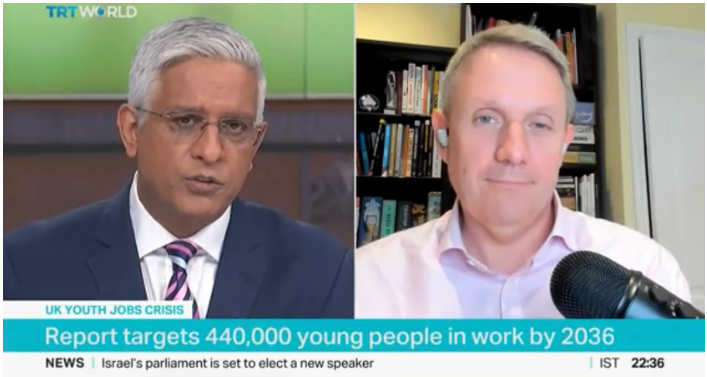
TV appearance yesterday responding to the Milburn report
How can I help you?
1. Talks, workshops and seminars: I am an award-winning speaker. My talks include recruiting and retaining Gen Z, understanding Gen Z, overcoming the challenges of the multigenerational workplace plus those relevant to the topics below. Speaker showreel here.
2. My book The Snowflake Myth is out now: to receive a free chapter please click here.
3. One to one coaching programmes for senior leaders
4. Team coaching programmes: working IN a team is not the same as working AS a team and yet they are often treated as if they are the same. I help teams move from the former to the latter, and generate huge shifts in productivity and outcomes.