The Myth of Unreliable: Debunking Gen Z in the workplace
Every workplace seems to have its stories of Gen Z unreliability.
‘They just don't turn up for interviews’.
‘They ghost us after accepting job offers’.
‘One deadline and they're off sick with stress’.
These narratives have become so commonplace that many organisations accept them as simple facts about Generation Z in the workplace.
Yet these stories can reveal more about outdated multigenerational workplace expectations than they do about an entire Generation Z recruitment challenge.
The accusation that Gen Z cannot be relied upon, entitled even, has become the most prevalent of all the myths surrounding this generation, and arguably the most damaging.
How can organisations get past The Myth of Unreliable?
Here's 4 aspects to consider.
TL;DR
The Myth of Unreliable stems from misunderstanding Gen Z characteristics rather than genuine character flaws. Understanding these intergenerational differences is crucial for organisations focused on recruiting and retaining Gen Z talent. Their apprehension reflects growing up in an over-managed, highly scrutinised world where failure is public and comparison is constant.
1. Why Gen Z seems unreliable at work (and why they're not)
Apprehension is a key characteristic of Gen Z.
This isn't about anxiety as a clinical diagnosis, but rather a learned caution developed through formative years spent in a world that tracks, measures and publicly displays everything.
Generation Z has grown up knowing how they're performing across countless metrics, from social media engagement to academic rankings to fitness statistics.
This constant comparison, whilst normalised for them, doesn't always serve happiness or confidence.
Intellectual self-confidence amongst Gen Z remains strong. Surveys show that approximately two-thirds judge themselves as higher than average performers yet social confidence presents a different picture, with respondents showing far more uncertainty (and unhappiness etc).
The perceived firepower exists to be used, if confidence levels could be high enough to access it.
This disconnect between knowing you're capable and feeling confident enough to demonstrate it creates the impression of unreliability when, in reality, it's hesitation born from living in a world where mistakes are permanent and public.
This is not an indication of an unreliable generation but symptoms of one that has learned to be cautious because the stakes of getting things wrong feel considerably higher than they did for previous generations.
Understanding these Gen Z characteristics is essential for organisations serious about recruiting and retaining Gen Z talent in today's competitive market.
2. Does Gen Z have more mental health issues than other generations?
The statistics on Gen Z mental health are indeed shocking, but they require context rather than dismissal. This generation reports far higher levels of stress, anxiety and depression than previous cohorts at the same age.
These elevated rates don't automatically translate to workplace unreliability. What's changed isn't just the prevalence of mental health challenges, but the willingness to acknowledge them and seek support. Previous generations simply didn't have the language, awareness or permission to discuss mental health openly.
The pandemic amplified existing trends rather than creating new ones. Gen Z grew up during a period of economic instability, climate crisis awareness and social media saturation that previous generations experienced differently, if at all.
Gen Z faces genuine economic pressures that impact mental wellbeing. Today’s young professionals will spend a far higher proportion of their income on housing than their parents did, with home ownership increasingly out of reach despite achieving the highest educational qualifications of any generation.
Organisations that view mental health disclosure as evidence of unreliability miss a crucial point: employees who can articulate their needs and boundaries are actually more reliable than those who suffer in silence until they burn out spectacularly.
Here’s a key bit of reframing. The generation requesting mental health days isn't necessarily less committed to work but better at recognising when continuing would be counterproductive.
Forward-thinking employers who understand intergenerational differences are discovering that supporting mental wellbeing through clear policies and genuine flexibility actually improves reliability rather than undermining it. When Gen Z employees feel supported rather than judged, retention and performance improve measurably.

The audiobook version of The Snowflake Myth is out now but possibly not yet everywhere! According to Apple, Kojo etc it should be out by the time this is published.
I will send a separate email out about it when it is definitely available in all the usual places. For updates please go to the book page on my website.
Here’s a preview link on the apple website
Black Friday deal - if you use the code ALEXBLACKFRIDAY - you can get the paperback for a very limited period for £8 inc P&P on my website (mainland UK only). This won’t last long so get your orders in!
Finally, congratulations to Sabrina Malcolm who won the chocolate hamper (more a box as it turned out, but there you go) - and whatdoyouknow - she sent me footage of the grand opening. Now that’s how to receive a prize!

Anyway, back to the blog…
3. Why Gen Z has side hustles (and why employers should support them)
We used to call it moonlighting and it was frowned upon.
The complaint that ‘Gen Z runs businesses outside of work and doesn't understand why this causes issues reveals a fundamental misunderstanding of contemporary economic reality’.
Gen Z has good reason to need a 5 to 9 after the 9 to 5 has finished.
What older generations label as moonlighting or disloyalty is, for Gen Z, a pragmatic response to economic insecurity. When a single income stream cannot reliably cover living costs or build towards major life goals, diversification becomes necessary rather than optional.
Gen Z witnessed the 2008 financial crisis during their formative years, learning that job security is illusory and companies won't necessarily support employees through difficult times. They've seen redundancies, restructures and the gig economy's rise. The side hustle isn't about lacking commitment to their main employer; it's about building security through multiple income streams because relying entirely on one employer feels unnecessarily risky. From a pragmatic perspective, only a minority of startups succeed, so maintaining employment whilst building alternative options makes financial sense.
Employers who view side hustles as problematic miss significant opportunities. Staff developing skills and building experience outside work hours often bring valuable knowledge back to their primary role. The employee running an online business develops marketing, customer service and financial management skills. The one with a photography side hustle understands visual communication and social media.
Rather than demanding exclusive commitment, savvy organisations recognise that employees working only their contracted hours whilst building external skills represent the best of both worlds. You attract talented professionals who do excellent work within agreed parameters, whilst benefiting from the additional expertise they develop independently.
The alternative, insisting on unlimited availability and exclusive focus, simply makes your organisation less attractive to high-calibre candidates who have other options. This approach to age diversity in the workplace recognises that different generations bring different strengths and working styles.
4. How to prepare Gen Z candidates for professional interviews
When employers complain that Gen Z candidates arrive unprepared for interviews, don't know what to wear, or fail to research the organisation, they're identifying a genuine skills gap rather than character deficiency.
This generation has had dramatically different preparation for working life compared to their predecessors. Most haven’t had the multiple work experience placements at school that once provided workplace socialisation. They may have been working in coffee shops and supermarkets, but they may be a poor equivalent for your work place. They've spent less time interacting with adults as colleagues and observing professional norms firsthand.
This isn't entirely Gen Z's fault. The decline in part-time youth employment reflects changed labour markets, increased educational pressure, and parental anxiety about balancing work with academic achievement. The result is a generation that enters professional recruitment processes with less practical understanding of workplace norms than their predecessors possessed at the same age.
What appears as poor preparation or unreliability is actually inexperience that previous generations gained gradually over years.
The solution isn't to bemoan this generation's inadequacy, but to adjust expectations and provide clear guidance. Person specifications need reviewing to separate genuine requirements from assumptions about knowledge candidates should already possess.
Job descriptions benefit from clarity about reporting structures, and professional expectations. Organisations that provide detailed information about interview processes, dress codes and what candidates should research dramatically improve application quality.
When Gen Z candidates understand what's expected in your multigenerational workplace, they overwhelmingly deliver. The challenge lies in making implicit workplace norms explicit for a generation that hasn't osmosed them through years of casual employment.
CLICK ABOVE 📹
Remember that
The Myth of Unreliable stems from misunderstanding Gen Z's context rather than genuine character flaws in this generation.
Apprehension developed through growing up in a risk-managed world where everything is tracked and measured affects confidence but not capability or commitment.
Mental health awareness represents progress in acknowledging challenges that always existed but were previously suppressed, and supporting wellbeing improves rather than undermines reliability.
Organisations investing in understanding Gen Z characteristics and adapting their Generation Z recruitment strategies see measurable improvements in retention and performance.
FAQ
Why do Gen Z candidates not show up for interviews?
Multiple factors contribute to interview no-shows. Some candidates genuinely lack understanding of professional norms around commitment to interview appointments. Others receive better offers between application and interview in a competitive market. Many feel overwhelmed by the interview process itself, particularly if they lack prior workplace experience.
The solution involves clearer communication about interview expectations, confirmation processes and making the overall recruitment experience less intimidating for candidates who may be navigating their first professional opportunities.
How can we address Gen Z's mental health needs without compromising productivity?
Supporting mental health and maintaining productivity aren't opposing goals. Clear policies around mental health days, manageable workloads and psychological safety actually improve long-term productivity by preventing burnout. Training managers to recognise early warning signs and respond supportively helps employees address issues before they become crises. Flexible working arrangements enable people to work when they're most effective.
The key is viewing mental health support as productivity investment rather than productivity cost. Truth be told, burnout was never a badge of honour whatever we thought at the time.
How much detail should we provide in job descriptions and person specifications?
Considerably more than many organisations currently offer. The key isn’t a long document but that everything included is genuine and links to other useful information is available (and ideally in video form) Include information about typical days, reporting structures, professional development opportunities and workplace culture. Specify whether hybrid working is available, how performance is measured, and what support new employees receive. Test out your messages with your current young employees.
Whilst this may seem excessive to experienced professionals, Gen Z candidates need this clarity because they haven't gained workplace knowledge through years of casual employment. Comprehensive information also filters out unsuitable candidates earlier, improving application quality.
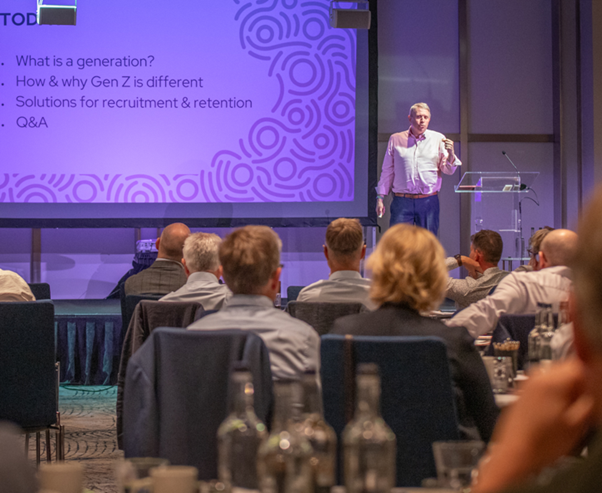
Speaking at the OPI conference in October
Alex Atherton is a Gen Z speaker and generations speaker who helps organisations navigate intergenerational workplace challenges.
Podcast
I had a great time talking to author, speaker, organisational expert and podcast host Helen Beedham for her ‘The Business of Being Brilliant’ podcast. Click the link below to listen.
How can I help you?
1. Talks, workshops and seminars - I am an award-winning speaker. My talks include recruiting and retaining Gen Z, understanding Gen Z, overcoming the challenges of the multigenerational workplace plus those relevant to the topics below. Speaker showreel here.
2. My book The Snowflake Myth is out now - to receive a free chapter please click here.
3. One to one coaching programmes for senior leaders who are swamped by their jobs so they can thrive in life. Click here to discover where you are on your journey from Frantic to Fulfilled? Just 5 minutes of your time and you will receive a full personalised report with guidance on your next steps.
4. Team coaching programmes - working IN a team is not the same as working AS a team and yet they are often treated as if they are the same. I help teams move from the former to the latter, and generate huge shifts in productivity and outcomes.