Bridging the AI Gap in Multigenerational Teams
The workplace is currently experiencing its most significant technological shift since the internet revolution.
As if you need me to tell you.
As was the case then, the revolution is not rolling out at the same speed across the generations.
For those new to my articles I will emphasise that the differences within generations are far bigger than those between. It will be the same in your workplace. Here, I’m talking about general trends and not absolutely.
Earlier workplace technologies required human direction at every step. Now the emails get sent, the meeting transcribed, the follow-up actions whirr away without you noticing.
Or at least, they can. But it does not play out the same way across a workplace’s age range.
There are gaps in usage, familiarity, expertise, frequency - you name it.
How to proceed?
Here's four aspects to consider.
TL;DR
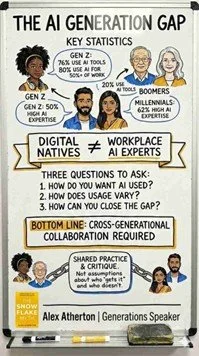
AI adoption varies wildly—76% of Gen Z use AI tools versus 20% of Boomers (Deloitte), yet Millennials lead in expertise at 62% (McKinsey). Closing the gap requires: understanding each generation's relationship with AI, clear communication of strategy from senior leaders, reverse mentoring programmes and workflows that combine all generations' strengths into something greater than the sum of its parts.
1. Generations varying relationships with AI
A lot of research is going on with this topic
76 per cent of Gen Z have used standalone generative AI tools like ChatGPT or Claude, compared to just 20 per cent of Baby Boomers (Deloitte)
Gen Zs (aged 18-21) use AI for ‘more than half of their work tasks’ in almost 80 per cent of cases (Aithor)
Around half Gen Z prefer asking AI work-related questions rather than approaching colleagues or managers
62% of Millennial employees aged 35-44 report high AI expertise, higher than Gen Z's 50% (McKinsey)
72% of Millennial managers are concerned about managing increasingly AI-reliant workforces (EY)
All of this raises three key questions for you in your organisation.
How do you want AI tools to be used?
How does the use of AI tools currently vary?
If it varies by age - how can you close the gap?
There’s a big difference between using a minor AI tweak within a well established tool like Gmail and setting up automations which connect platforms and save hours.
‘Seeing what happens’ is not a long-term strategy.
‘The young ones get it but the older ones never will’ isn’t either (and isn’t true).
Unless practice is shared, explicitly, and time spent on doing so - you will never close the gap.
Making the most of AI tools, and offsetting their limits, means getting people together to share what they do and have others critique it.
Resolving this issue requires cross generational collaboration.
2. Getting the strategy right at the top
Only half of senior leaders say their organisation has clearly communicated its AI strategy.
This research from EY shows that the rest of the organisation thinks that is a generous assessment. ‘Employees’ were around 10%.
You cannot communicate a strategy that you have not written (or that you don’t understand because AI wrote it).
EY found that organisations who both have a strategy and communicate it well see significant productivity gains. The shop floor needs clarity, rather than an invitation for everyone to make it up as you go along.
Complex and significant change needs a communication strategy to match.
The ‘town hall’ meeting to get the strategy across.
Practical, hands on sessions with preferred tools.
Key principles outlined in writing.
Ongoing dialogue, shaped across the organisation.
It all needs investment to see the return.
There’s a reason why half of CEOs do not yet see increases in productivity (but they likely will with alignment).
A lot of people feel understandably overwhelmed by the constant influx of new applications and their implications.
Key messages will need to be repeated, including on how they are shaping and communicating a strategy over time.
This is ongoing work-in-progress, which requires a workforce to spend time together discussing what they have and not jetting off in all directions.
Alignment still matters, and without some key principles behind them it will disappear.
3. Reverse mentoring can bridge the gap
Is there a better topic for reverse mentoring than AI?
Already nearly two-thirds of Gen Z employees actively help older colleagues adopt AI tools (International Workplace Group - 2025). This support takes different forms from hands-on guidance to sharing practical tips.
But, as with any reverse mentoring programme, be careful not to dive in without a little planning.
Reverse mentoring requires careful structuring to succeed, not least because of the ‘expertise paradox’ in this topic.
Whilst Gen Z leads in usage frequency (Deloitte), they trail Millennials in expertise (McKinsey).
Younger workers may need some training in delivery before they start to deliver. Not everyone may share their comfort with experimentation.
EY's research found that even those Gen Z workers who rated themselves as ‘very knowledgeable’ about AI scored poorly when it came to writing prompts.
Older workers may need some time and space to develop their confidence. Using AI tools to carry out tasks which they may have considered to be their strengths involves psychological rather than knowledge barriers. Developing a ‘beginner’s mind’ when decades into a career is not always straightforward.
An ‘early adopter/reluctant adopter’ model can work too, whether cross generational or not.
4. Start with workflows
The humble workflow.
A few parts of a process, some now done by a machine.
Simple in theory.
This may sound ridiculous now, but I do not remember this word being in common use until relatively recently.
Bear that in mind as you make a start.
Basic AI implementations simply accelerate an existing process, but this may feel a real breakthrough for those new to it.
Moving to Agentic AI, where workflows are distinguished between tasks best suited for autonomous AI, tasks requiring human-AI collaboration, and tasks demanding pure human judgement is a whole new thing.
So start small and build confidence up.
And don’t rush to overestimate the number of hours freed up. Automations need to be checked and managed.
Platform updates knock them out of sync for no apparent reason. The hours you saved one day may be lost to fixing it the next.
But that also is something to work on together.
The same applies to the ‘key principles’ which may run out of date frequently, but can be revised in the same ways as they were created. That includes collaboration from the ground up.
The goal is workflows where (stereotype alert!) Gen Z's rapid AI adoption, Millennials' high expertise, Gen X's balanced perspective and Boomers' organisational experience combine productivity greater than the sum of its parts.
Remember That
The generational AI divide is statistically dramatic, yours may well be the same. This is a good reason to know your starting points, then work out how you can close the gaps rather than assume the horse has bolted.
Don’t assume that everyone will be fully into it. There’s a reason why turkeys don’t vote for Christmas. Frame the discussion in terms of how the organisation can achieve more, rather than delegate 40% of the work to AI and start work on the redundancy plan.
AI may enable productivity, but using it well involves a lot of deep work. That has an impact on what else can be achieved. Running the staff into the ground as facilitated by AI is not a good look.
FAQ
Q1: Our Gen Z employees are using AI extensively but our senior leaders are hesitant. How do we bridge this gap without forcing adoption?
Start with education rather than mandates. The statistics show 71 per cent of Boomers have never used ChatGPT, yet 80 per cent have a foundational grasp of AI concepts and 58 per cent believe AI will change their everyday lives.
This suggests awareness without hands-on experience. Create low-stakes experimentation opportunities where senior leaders can try AI in familiar contexts.
Nearly half of Boomers say they would use AI if it were integrated into technology they already use. There’s a case to be optimistic if your programmes are right.
Q2: How do we provide AI training when our workforce spans five decades with vastly different technological starting points?
Hire a multigenerational workforce consultant!
Beyond that 🙂create multiple pathways rather than a single programme and let people find their own.
There are many ways of getting to where you want to get to. Forcing everyone through identical training wastes resources. And remember even the best staff are behind where they will need to be in 12 months’ time.
Alex Atherton is an award-winning generations speaker and leadership coach who helps organisations navigate multigenerational workplace challenges. Author of The Snowflake Myth, he specialises in Gen Z recruitment and retention, and leadership development.
How can I help you?
Talks, workshops and seminars - I am an award-winning multigenerational workplace speaker. My talks include recruiting and retaining Gen Z, understanding Gen Z characteristics, overcoming the challenges of the multigenerational workplace, and bridging the human-AI collaboration gap across generations. Speaker showreel here.
My book The Snowflake Myth is out now - to receive a free chapter please click here.
One to one coaching programmes for senior leaders who are swamped by their jobs so they can thrive in life. Click here to discover where you are on your journey from Frantic to Fulfilled? Just 5 minutes of your time and you will receive a full personalised report with guidance on your next steps.
Team coaching programmes - working IN a team is not the same as working AS a team and yet they are often treated as if they are the same. I help teams move from the former to the latter, and generate huge shifts in productivity and outcomes.