Managing a workforce spanning four generations is your reality in 2025.
And whether you believe in the concept of generations or not - it is unequivocally true that the age range in the average workplace is increasing.
In just over two decades the percentage of 65+ who are in the workforce has more than doubled in the UK (from less than one in twenty to more than one in eight).
When your age range goes from 18 to 80 there is a wide range of experience in the room.
It might feel easier to let everyone slide off to their corners. Too difficult to bring all your Baby Boomers (62-80 in 2026), Gen X (46-61), Millennials (30-45) and Gen Z (15 to 30) together.
But a leader’s approach can’t be one-size-fits-all at the best of times. And if age diversity is treated as a burden rather than an organisational asset that won’t help either.
So what to do?
Here’s four aspects to consider.
TL;DR
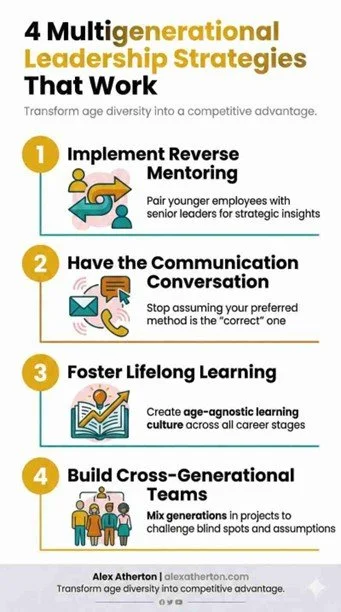
Managing multigenerational workforces requires transforming age diversity into competitive advantage. Reverse mentoring pairs younger employees with senior leaders, providing executives with insights into digital trends and emerging values. Communication friction emerges when assuming one method fits all. Training must simultaneously upskill older workers on digital tools whilst developing Gen Z soft skills.
1. Implement reverse mentoring and do it properly
Traditional mentoring assumes wisdom flows downwards from experienced to inexperienced.
But it’s not the only model.
Your younger staff possess critical insights into digital trends, consumer behaviour patterns and cultural shifts that senior leadership desperately requires to remain relevant.
Reverse mentoring pairs younger employees with senior executives, not to ‘fix’ older workers but to provide leaders (and others) with perspectives they are missing.
This is not about teaching your CEO to use TikTok (although let’s not rule that out).
Primarily, iIt is about validating the expertise of your youngest talent, whilst simultaneously breaking down hierarchies that stifle innovation.
When a 24-year-old Gen Z employee mentors a 55-year-old director on emerging workplace expectations around transparency or purpose-driven work, both parties gain.
The director learns what drives retention among younger cohorts.
The Gen Z employee gains visibility, confidence and direct access to decision-makers.
Structure matters, by which I mean
A sense of a formal programme with clear goals, confidentiality agreements and defined time commitments.
Ground rules about length of programme, frequency of meeting time and topic per session.
And not grimacing through vague knowledge sharing sessions. If you are going to do it then do it properly.
This means a culture of executive development, not remedial training, which supports succession planning, retention and innovation.
2. Have the communication conversation
Are you emailing people who live on Slack?
Are you asking people to use Slack who don’t know what it is?
Are you calling people who view unscheduled phone calls as intrusive?
Communication method mismatches are the primary source of intergenerational workplace conflict, yet they are treated as trivial complaints rather than structural barriers to productivity.
And there are many valid approaches to solving a problem. Face-to-face, voice notes and those email chains we all love.
If your starting point is that there is only one way then be prepared for a problem.
According to People Management research, 47% of respondents believe Gen Z lack satisfactory communication skills, whilst only 11% say the same of Gen X.
This perception gap reveals the problem. Gen Z do not lack communication skills. They communicate constantly, rapidly and effectively using tools many older leaders dismiss or misunderstand.
The skills mismatch works both ways. Many senior leaders lack competence in the communication platforms Gen Z uses fluently.
Stop assuming your preferred method is the ‘correct’ one and open up to other ways of doing things. It might unpick some deep rooted default modes that weren’t serving you (and others) in the first place.
The ‘big communication question’ is intended to take people out of their comfort zones.
The urgent, complex or sensitive matter might require nothing other than face-to-face or video calls. It’s not one for the WhatsApp group.
Quick updates, clarifications or task assignments might suit instant messaging.
Formal decisions, documented processes or compliance matters need email trails.
The key is establishing clear protocols over time and allowing others time to catch up where necessary.
Preferences are often related to skill levels. Address that first, and then have the conversation.
3. Foster lifelong learning across generations
The shelf life of skills can be shorter than ever.
But if your training budget disproportionately targets early-career Gen Z employees whilst ignoring your Millennials, Gen X and Boomers then you may discover that ignorance is a lot more expensive than training.
At the risk of stereotyping, older workers require upskilling in digital tools, AI literacy and evolving workplace technologies just as urgently as younger workers need training in soft skills, leadership capabilities and institutional knowledge that cannot be learned from Google.
Create a culture where learning is continuous, age-agnostic and valued at every career stage. This is not about sending everyone on generic training courses. It is about identifying skill gaps systematically, providing targeted development opportunities and removing the stigma that learning needs are developmental failures.
Organisations that invest in lifelong learning signal to all employees that everyone has a future, regardless of age.
Having this as a fundamental element of your culture also goes a long way to ensuring you can have the multigenerational workplace you really want, rather than working out what to do with the one you currently have.
How good are your skills audits? What levels of engagement do they receive?
Is training a one size fits all affair? What scope is there for your colleagues to find their own way?
What expectation is there of colleagues sharing their learning with each other, and across age ranges?
A strong learning culture applies to everyone, not just your youngest onboarders.
4. Build Cross-Generational Teams
A successful multigenerational workplace can only happen if you have successful multigenerational teams.
It seems obvious but silos can still be the default model. And it is still rare for an organisation to have a strong sense of the age profile of their component parts.
If your marketing team members are all younger than 30 whilst your strategy team is over 50, then you are at risk of a structural problem.
Mix your people up in project teams, working groups, decision-making committees and anywhere else where they need to come together.
This might feel uncomfortable initially, and unfortunately this can be enough to stop some organisations getting any further.
61% of employers agree there are significant differences in work culture preferences among generations (according to Work Foundation research) but that discomfort can also produce better work.
Better outcomes come from teams that challenge each other's blind spots, question assumptions and generate solutions neither would reach independently. That little edge of friction is productive, not destructive, when managed well.
Cross-generational project teams can also cut through the organisation chart, and build the kind of collaborative culture which acts as a serious motivator.
A high functioning multigenerational workplace can be an organisation’s biggest competitive advantage. It is worth the management headaches to get to the other side.
Remember that
Multigenerational workplace success requires moving beyond tolerance to active leverage of age diversity as competitive advantage
Learning must be continuous and age-agnostic, with training addressing digital skills for older workers and soft skills for younger ones simultaneously (and vice versa).
Recognition, feedback and reward systems built for Baby Boomer career patterns fail to motivate or retain younger generations facing different economic realities. Don’t miss it out of the conversation.
FAQ
What are the biggest challenges in managing a multigenerational workforce in the UK?
Communication style differences, varying flexibility expectations and divergent career progression assumptions create the most friction. According to Work Foundation data, 61% of UK employers report significant differences in work culture preferences among generations. The challenge is not acknowledging differences exist across ages but implementing tactics that leverage them productively.
How do you implement reverse mentoring without senior leaders feeling patronised?
Frame reverse mentoring as executive development, not remedial training. Focus on strategic topics like emerging market trends, consumer behaviour shifts or future workforce expectations rather than basic technology training. CIPD recommends 3-6 month cycles with clear objectives and confidentiality agreements. When senior leaders gain genuinely useful strategic insights from younger mentors, patronisation concerns disappear.
Why do Gen Z employees expect more frequent feedback than older generations?
Gen Z grew up with instant feedback loops through social media, gaming and digital platforms. Waiting 12 months for performance feedback feels agonising when they are accustomed to real-time responses. Deloitte's 2024 research shows this is not entitlement but a different feedback paradigm shaped by technological context. Monthly check-ins satisfy Gen Z needs without overwhelming managers or annoying employees who prefer less frequent contact.
What help is available so we can make progress?
Look no further for a multigenerational workplace speaker who knows about Gen Z characteristics! Message me for a conversation.
Alex Atherton is an award-winning Gen Z speaker and generations expert who helps organisations navigate multigenerational workplace challenges. Author of The Snowflake Myth, he specialises in Gen Z recruitment and retention, and leadership development.
How can I help you?
Talks, workshops and seminars - I am an award-winning speaker. My talks include recruiting and retaining Gen Z, understanding Gen Z, overcoming the challenges of the multigenerational workplace plus those relevant to the topics below. Speaker showreel here.
My book The Snowflake Myth is out now - to receive a free chapter please click here.
One to one coaching programmes for senior leaders who are swamped by their jobs so they can thrive in life. Click here to discover where you are on your journey from Frantic to Fulfilled? Just 5 minutes of your time and you will receive a full personalised report with guidance on your next steps.
Team coaching programmes - working IN a team is not the same as working AS a team and yet they are often treated as if they are the same. I help teams move from the former to the latter, and generate huge shifts in productivity and outcomes.