Are Gen Z Skiving or Burning Out?
Which of these two headlines is more true in your organisation?
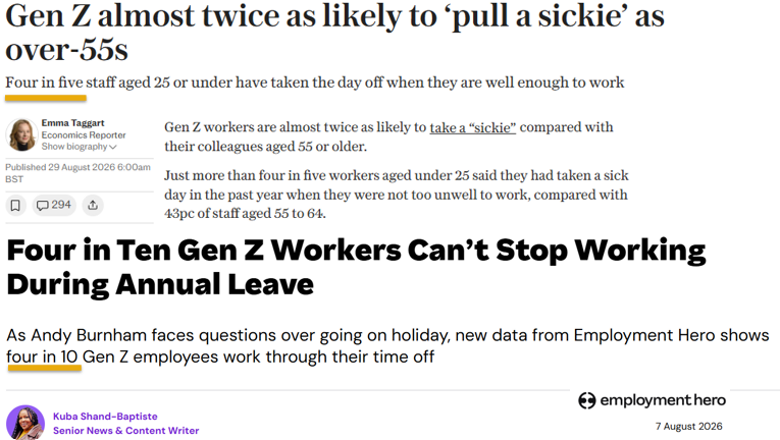
And how do you know?
You might have figures for the first one, but maybe not the second.
There’s crossover between these stats too. If 80% of Gen Z ‘pull a sickie’ and 40% work through their time off then these two groups are not mutually exclusive by definition.
How to approach it in your organisation?
Here’s four things to consider.
-
The Centre for Social Justice found four in five under-25s had taken at least one sickie in the past year. Employment Hero found 41% of Gen Z work every day of their annual leave against 27% of UK workers overall. There’s lots of issues in these statistics and there’s more in the finding that only a quarter of UK employers are very confident their managers can lead across generations.
1. Both have issues with boundaries. Are you the same?
In theory it is simple. When you are on leave you shouldn’t work, and when you are fit enough to work you turn up.
But for a very large majority of Gen Z, possibly even all, one of these boundaries is crossed.
The likelihood is that the employer is well up on the deal. One to a few unwarranted sickness days is significantly outweighed by working through their whole annual leave.
Is this the outcome of your company culture?
When any professional says, “I’m on leave next week but it’s fine you can contact me” do you push back on that or say it would be helpful?
Boundaries only exist in workplaces when leaders reinforce them. Which of yours only exist on paper.
2. Find out your version of the story
I posted these images on LinkedIn recently - lots of people looked at and very few commented.
Which made me wonder how many people are confident about their answer to the question.
And if you do not have an answer to the question you are unlikely to be able to break it down by age either.
80% of under 25s may have ‘pulled a sickie’ at least once. Half of them did it five or more times.
One in ten ‘older workers’ did the same. It all adds up.
Without your own stats you do not know how big a problem you have got. And while we are here, what’s YOUR answer to the question?
The same applies to the extent to which the quality of work falls because your people do not take their leave. 39% of Gen Z ‘struggle to disconnect’ on holiday, almost twice the national rate.
The extent to which you and your organisation has a wobbly relationship with boundaries will vary, and it can be very expensive.
3. Your managers have already picked a side
And let’s face it, it’s the sickie one.
I’m going to stereotype for a reason.
“If they can’t switch off on holiday, that’s their problem. But when I’m expecting them in, they had best turn up”.
There is some logic in this, and it’s about managing expectations.
Often I have to do the same with managers.
CMI's July 2026 report Bridging the Gap, (based on 1,000 UK managers and a YouGov poll of 500+ 18 to 24), found that 61% of managers believe younger workers are more likely than other age groups to lack resilience, professionalism, communication skills and the ability to accept and act on feedback.
The same report found 70% of young people feel employers hold a negative bias against their generation.
When the sickie headline runs, it lands on ground that has already been prepared. There’s a reason it got more media traction than the ‘work through annual leave’ story.
But both are a problem, and focusing only on the sickies will not endear you to your young professionals.
4. Don’t ask which one is true
And yes I know that’s how this article started.
The better question is to ask which of your people each one describes, and why.
While you are on it, break down the data you have already. Split your absence and leave data by role and by tenure, as well as by age. I’m going to stick my neck out and say it’s unlikely that a ‘sickie culture’ is underpinned by low rates of sickness absence. The sickies are on top of all of that.
The cost of ‘working through annual leave’ tends to be more sickness absence, lower performance and higher attrition rate. In the short run the employer might think they are gaining from an ‘always on mentality’. Long-term reality is likely to be different.
What leaders should do next
Analyse your last twelve months of absence data by team and tenure. What does that information tell you?
If 40% of your early-career people are working through annual leave, that is not dedication. It is a boundary nobody has drawn for them. How good is your onboarding procedure at drawing boundaries on raising ‘elephant in the room’ topics?
If these two boundaries are compromised in your organisation they will not be the only ones. Have the conversation around the senior team table about the others.
FAQ
Four in five under-25s admitted pulling a sickie. Isn’t that just a catastrophic issue?.
Agreed, but my argument is about what you do next. If you conclude "young people are workshy" you will reach for monitoring and warnings. If you conclude "people in insecure early-career roles with untrained managers take unplanned days off" you will look at rotas, workload and the quality of the return-to-work conversation. Same data. One of those responses changes the number.
Our engagement survey shows clear differences by age/generation. Are you saying our data is wrong?
Not wrong, just saying your generational cut is also a tenure cut, a seniority cut, a pay-band cut and probably a department cut, because your younger people are concentrated in particular roles. Re-cut the same responses by tenure and by manager and see which split explains more.
Alex Atherton is a Gen Z speaker and generations expert who helps organisations navigate multigenerational workplace challenges. Author of The Snowflake Myth, he specialises in Gen Z recruitment and retention and leadership development.

Alex Atherton speaking at TEDx Northern Quarter on Friday 11th September 2026
How can I help you?
Talks, workshops and seminars - I am an award-winning speaker. My talks include recruiting and retaining Gen Z, understanding Gen Z, overcoming the challenges of the multigenerational workplace plus those relevant to the topics below. Speaker showreel here.
My book The Snowflake Myth is out now - to receive a free chapter please click here.
One to one coaching programmes for senior leaders
Team coaching programmes - working IN a team is not the same as working AS a team and yet they are often treated as if they are the same. I help teams move from the former to the latter, and generate huge shifts in productivity and outcomes.