Be fluffy, not woolly
Once again I was stuffing my face with high end corporate sandwiches (it’s a tough life).
I had spent the morning with the senior leadership team of a law firm. Over lunch, one of them said one of those things I had to stop and write down immediately.
"I get now that with Gen Z it's a bad thing to be woolly. They really want to know exactly as it is."
I was mid-sandwich and nodded approvingly.
Then he stopped and added, "but I can also see we need to get the fluffy stuff right."
It might be a Gen X interpretation but I really like it.
So what exactly did he mean? And how can you apply the same principles in your organisation?
This week’s blog has four aspects to consider.
-
‘Fluffy’ might be a pejorative term, and one associated with Gen X (perhaps) but what used to be ‘nice extras’ are now essential. To be ‘woolly’ used to be a skill and now it’s a red line. Gen Z's standard for clarity, transparency and authenticity is considerably higher than many from older generations believe.
1. Clarity on the concepts
Here’s a favourite line from the BBC sitcom ‘Yes, Minister’. The context was two senior civil servants discussing who would get the soon to be vacant Prime Minister role.
The best way of getting it was to ensure that the desired candidate should ‘not express any firm opinion on anything at all’.
Life has changed*. It’s better to say what you really think rather than what you think someone wants to hear.
To be woolly, to obfuscate the facts and to avoid answering the question were all seen as political skills. But Gen Z saw through it a long time ago and was prepared to call it out when they heard it.
Gen Z's standard for clarity is far higher than older generations think it is. The same applies to authenticity and transparency.
Woolly - defined as not saying that you mean or are unclear about how you say it.
You might think you have been clear, and twenty years ago you might not have had the challenge coming back the other way, but you need to find out if you have been understood. Don’t assume.
I hesitate to define ‘fluffy’, because what used to be seen as optional extras are now fundamental. That shift has partly come because organisations have understood the value and the difference they can make to productivity.
So (deep hesitant breath) I mean things like
· Mental health support
· Employee assistance programmes
· Flexible working
· A structured onboarding programme
· Structured professional development
Calling any of those ‘fluffy nice to haves’ would give you some strange looks these days. A Gen X definition of ‘fluffiness’ is now represented by a pragmatic set of options.
*Need proof? Starmer won a huge majority and lasted two years. Trump was re-elected. Which one is clearer about who they are and what they are about?
2. How woolly is your company culture?
Got a mission statement? Nice one, go tick that box.
Vision statement? As well as mission I hear you say? Tick that one too.
What about values? Please tell me there’s at least six. You couldn’t narrow it down from eight at the C-suite away day after THAT argument? Awesome! Put a BIG tick for that one.
I’m being facetious. But there’s a lot of guff written on company walls (notice ‘guff’ is very different from ‘fluff’)
And the woollier all those words and slogans are, the greater the chances that you actually have no real sense of company culture at all. Or worse, the vacuum from not having one has been filled by toxicity.
Worse still, if what you tell your customers you are all about is the opposite of what your employees experience then expect that to mean something. Alignment across the public and employee perceptions is more important than it used to be. It is much harder to keep a lid on a poor culture.
Lots of words meaning nothing is one of the best ways to avoid high calibre young professionals.
3. From ‘don’t be woolly, be fluffy’ to ‘be clear’
Here’s an example of one typical generational blind spot.
50 year old senior leaders learned progression by watching it happen to other people over ten years, possibly including their line manager. They had time to decode it and identify the unwritten subtleties of how it all worked. That’s what some line management meetings were for.
Gen Z wants the criteria to be written down and stuck to, and does not appreciate being told that is a bit much.
Don’t interpret this as impatience, it is a request for specifics. If you cannot say what a promotion requires, ultimately you do not have a promotion process (and it might be seen as a preference).
There is a line between being clear and being direct, particularly when it comes to giving feedback, but my advice would be to focus on the former. If it is feedback related then make the next steps clear, including any they need to work out themselves.
4. "You said, we did"
How long is your list?
Asking people what they think is easy and most organisations do it. Closing the loop in public is the hard half, and it is the half that gets missed.
To be honest I see it quite a lot and ‘you said, we did’ actually doesn’t go far enough. Memories can be very short and you need to remind people that you did it.
Without that the action you haven’t taken can be foremost in people’s attention and not the ten you actually did. Don’t leave others to join the dots for you, keep putting the big picture back in front of them.
Better still give some detail of the story. Who asked you to do something? When and what for? What happened as a result and what was the impact? Again, don’t leave it to others to form the narrative. Create your own and make sure it is easily found.
Remember that no visible response is worse than no survey, because you have now demonstrated that asking is a ritual rather than a mechanism. Gen Z does not object to the survey. They object to being asked twice with nothing in between.
‘You said, we did’ can also buy you credit the next time you need to put your foot down and demand delivery. Reminders that this workplace doesn’t always work this way can hold to a little commitment.
What leaders should do next
Check you were understood rather than assuming you were clear. At the end of the next significant conversation, ask them to tell you what they are going to do. If it does not match what you meant, that is data about you, not them.
Check whether anyone can ‘fail’ your values statement. As well as what happened the last time someone did. ‘We value openness’ becomes ‘managers tell their team the headcount decision within 24 hours of knowing it’. If nobody can fail it, it is not a standard. Does your team meet it consistently? More to the point, do you?
Update the ‘you said we did’ list. What do you mean you don’t have one? It can be a cathartic experience to build it. It might actually be a lot longer than you think.
FAQ
What do Gen Z want from their managers?
Clarity goes a long way. Quality feedback means that next steps are clear not that something unclear just needs to be communicated again. CIPD's Good Work Index 2025, covering 5,017 UK working adults, found 62% say their manager gives helpful feedback, leaving nearly four in ten who do not. Where are you on this scale?
Isn't insisting on data just a way of dodging the human stuff?
No, it is how you protect it. CIPD's Good Work Index again - people who say work harms their mental health are more than twice as likely to quit within a year. Vagueness (or woolliness) can contribute to these problems more than you might imagine.
Alex Atherton is a Gen Z speaker and generations expert who helps organisations navigate multigenerational workplace challenges. Author of The Snowflake Myth, he specialises in Gen Z recruitment and retention and leadership development.
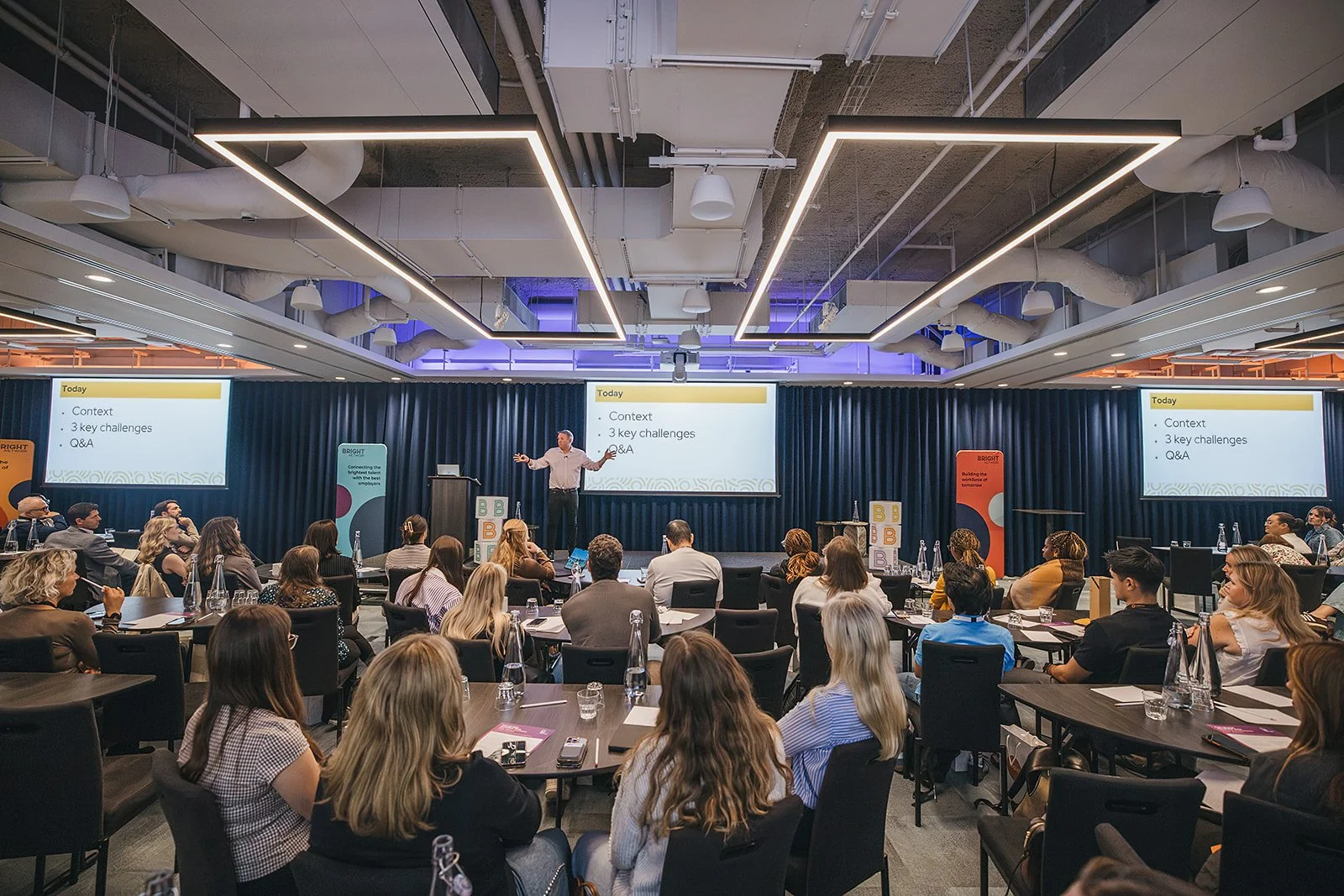
Alex Atherton speaking at the Bright Network Illuminate Conference last week
How can I help you?
Talks, workshops and seminars - I am an award-winning speaker. My talks include recruiting and retaining Gen Z, understanding Gen Z, overcoming the challenges of the multigenerational workplace plus those relevant to the topics below. Speaker showreel here.
My book The Snowflake Myth is out now - to receive a free chapter please click here.
One to one coaching programmes for senior leaders
Team coaching programmes - working IN a team is not the same as working AS a team and yet they are often treated as if they are the same. I help teams move from the former to the latter, and generate huge shifts in productivity and outcomes.
SOURCES
Or further reading
CIPD, Good Work Index 2025, June 2025. https://www.cipd.org/globalassets/media/knowledge/knowledge-hub/reports/2025-pdfs/8868-good-work-index-2025-report-web1.pdf
Chartered Management Institute, Bad managers and toxic work culture causing one in three staff to walk, 16 October 2023. https://www.managers.org.uk/about-cmi/media-centre/press-releases/bad-managers-and-toxic-work-culture-causing-one-in-three-staff-to-walk/
UK Government consultation on equal pay and pay discrimination, open until 27 October 2026, as summarised by Lewis Silkin, 16 July 2026. https://www.lewissilkin.com/insights/2026/07/16/uk-pay-transparency-in-recruitment-pay-ranges-in-job-adverts-are-under-consultation
Government response to the Home-based Working Select Committee report, 4 March 2026. https://www.gov.uk/government/publications/government-response-to-the-home-based-working-select-committee-report/government-response-to-the-report-of-the-house-of-lords-home-based-working-select-committee-web-version