Stop waiting for your future of work
It’s already arrived.
A decade ago I was taking secondary school assemblies and saying things like ‘a lot of the jobs you will be doing have not been invented yet’.
If I’d been smarter I’d have also said that there will be tasks you can monetise which are currently not the case, and some of you will be earning a living that way.
And of course ten years later I’m doing it myself.
But claims like ‘we have no idea what jobs will exist in ten years’ or ‘AI will take all the jobs’ are also lazy.
We don’t know all the jobs which will exist in ten years’ time but we also know more about the future of work than we pretend.
The same applies in your organisation.
Two key reports were published recently in the UK. These were Skills England’s first annual report and the DWP report written by Alan Milburn on NEETs, young people and work. I recommend reading both.
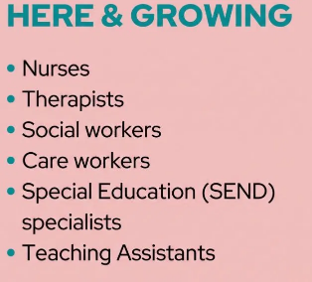
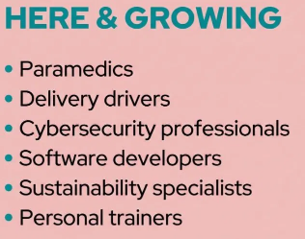
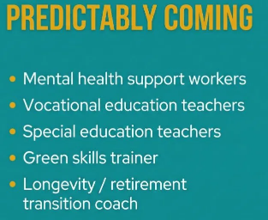
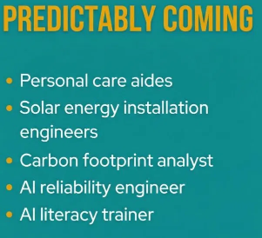
The fastest-growing roles in the UK economy have been around for many years. They include nurses, therapists, care workers, social workers, paramedics and teaching assistants. The forces that are driving growth right now, such as an ageing population, a mental health crisis and a climate crisis were all visible years ago.
The biggest growth stories are human ones.
But what does it all mean for you as an employer?
Here’s four aspects to consider.
TL;DR
The ‘we don't know what jobs will exist’ line is a comfortable excuse, not an honest analysis. Skills England and the Milburn review together show the pattern clearly: the biggest growth is in human-facing roles that have existed for decades, driven by ageing, mental health and climate. Nearly a million young people are locked out of a labour market that has narrowed its own entry routes. Organisations know enough to act despite the uncertainty.
1. Your pipeline is narrower than you think
The Milburn review helpfully publicised that nearly 30% of young people currently not in education, employment or training have ‘good GCSEs’ or equivalent.
What’s more, 21% have a Level 3 qualification and 15% have a degree. These are not unqualified candidates.
Then there’s the fact that the entry routes have got thinner. Apprenticeship starts for young people have fallen 40% in a decade. Remote, automated and algorithm led recruitment has replaced the human interaction that may have given unproven candidates a chance.
Applicant Tracker Systems (a topic for another day) can double down on these issues, depending on how they are used.
Do you have qualified candidates that your recruitment process is not reaching? Or, worse, you are reaching them but then screening them out before you are even aware.
Practical steps:
At which stage in your recruitment process does a candidate first speak to a human being? If the answer is ‘interview’, you are already missing out.
Look at the last 20 people you hired. How well did your process work for each of them?
Review your entry criteria for your most junior roles. Are they genuinely predictive of performance, or are they inherited from a job description written fifteen years ago (now embedded within an ATS)?
2. You may already have the skills you need
Skills England's first annual report and the new UK Standard Skills Classification — available at skillsclassification.org/core-skills — name 13 core skills for the modern workforce. Digital literacy, numeracy, listening, speaking, adapting, working with others, leadership and creating (anyone here from education remember the PELTs?).
The majority are human behavioural skills.
And the ones most in demand for the ‘1.8 million priority jobs projected by 2035’ are not primarily technical.
But if your systems, and culture too, only measures job titles and formal credentials and not capabilities you are missing out.
Read my blog on skills-based careers here.
Young people develop communication, resilience and problem solving through weekend jobs, caring responsibilities and other forms of informal experience. Skills England says this explicitly. The skill exists but the recognition system does not.
Practical steps:
Look at the 13 core skills taxonomy. What is your equivalent? If you don’t have one, what language are you using instead? Does it serving you?
When you write job descriptions, are the competencies listed actually assessed at any point in the process or are they aspirational noise that looks good on paper?
3. Work experience works when it carries real responsibility
Skills England states that work experience is the single most effective intervention for building employability skills.
It is also almost entirely wasted when the placement amounts to observation, tea-making and a week of shadowing someone who doesn't have time to explain what they're actually doing.
How well does it work in your organisation?
And how good are you at closing the gap which has been left to you to close?
The Milburn review reinforces this from a different angle. Young people arriving in the workplace often lack confidence not because they lack ability, but because the system has not given them anywhere to prove it.
Educational institutions are good at giving clear instructions and frequent feedback, it’s one key reason why Gen Z’s academic performance is off the scale. Workplaces are not so good at either. That gap is structural, not generational, and you can help to close it.
If your early careers programme is designed around task completion and compliance training, it is not developing capability.
Ask yourself this week:
Map the first 90 days of your onboarding programme (and if you don’t have one, create one). How many of those activities actually require the new starter to make a decision, take responsibility or handle ambiguity?
Where are the moments where a junior employee could carry real accountability? Are those moments currently given to them, or reserved for someone more senior?
What does your work experience provision actually teach? And does it strengthen your pipeline of candidates later down the line?
4. Design your multigenerational workforce for the answers
Skills England's report states plainly that school leavers cannot fill the 1.8 million priority jobs alone.
‘Significant reskilling of the existing workforce will be essential’.
That means your 45-year-old project manager, your 52-year-old administrator and your 58-year-old engineer are part of the solution. If you build routes for them to develop and if your youngest employees are part of the knowledge exchange, you can still succeed where others throw their hands up.
In this instance the value of the multigenerational workplace is about capacity, not culture. A well-designed multigenerational team transfers institutional knowledge from older workers to younger ones and brings digital fluency and emerging skills from younger workers back up the chain. Neither direction works without deliberate structure and planning.
Reverse mentoring programmes can be great, but if they all fall apart within months you are falling short. The ones that survive are embedded in succession planning, digital upskilling or SOMETHING. But always with a clear owner and a measurable outcome.
Ask yourself this week:
Where in your organisation is knowledge transfer happening informally between generations — and what would happen to that knowledge if your older workers left tomorrow?
Do you have a formal reverse mentoring programme? If yes, is it attached to a business objective or a cultural nicetyniceity? The former survives. The latter doesn't.
Remember that
● The pipeline problem is partly a process problem. Qualified young people are being filtered out by recruitment systems that were not designed for the workforce they now face. Audit your process before you blame the candidates.
● Informal skills are real skills but they may not be obvious from a set of qualifications. In fact I’ll be more up front - they are not at all obvious.
● The reskilling required to fill 1.8 million priority jobs by 2035, and whatever the priority jobs are in your organisation.
● Skills policy is now local. After April 2026, the provision available to your organisation depends on your geography. If you do not know your Strategic Authority and what they are investing in, find out this week.
FAQ
1. Our apprenticeship levy spend is mostly on leadership programmes for existing staff. Should we redirect it?
That depends on what you actually need. If your leadership pipeline is thin, the spend may be justified. But if you are simultaneously struggling to recruit young talent and running a levy-funded MBA cohort, then take a look.
2. There’s a lot we can’t predict, so what do we do?
You aren’t alone. But an agile, human, multigenerational workforce will offer you a lot of possibilities.
3. How do we convince line managers to take on the pastoral burden which comes with young staff without burning them out?
You probably can't ask them to take it on without training, clear referral pathways and active acknowledgement that it is part of their role — not an add-on. The organisations that do this well build it into their management development programme explicitly. Burning out your managers trying to fix your NEET pipeline is not a viable strategy.
Alex Atherton is a Gen Z speaker and generations expert who helps organisations navigate multigenerational workplace challenges. Author of The Snowflake Myth, he specialises in Gen Z recruitment and retention and multigenerational leadership development.

Sold out with three months left! I’m proud to be part of TEDx Northern Quarter.
How can I help you?
Talks, workshops and seminars — I am an award-winning speaker. My talks include recruiting and retaining Gen Z, understanding Gen Z, overcoming the challenges of the multigenerational workplace plus those relevant to the topics below. Speaker showreel here.
My book The Snowflake Myth is out now — to receive a free chapter pleaseclick here.
One to one coaching programmes for senior leaders
Team coaching programmes — working IN a team is not the same as working AS a team and yet they are often treated as if they are the same. I help teams move from the former to the latter, and generate huge shifts in productivity and outcomes.