Your 2026 recruits aren't ready. Are you?
Your September intake of new recruits is about to arrive!
Excited?
New passes, lanyards, a (soon to be updated) welcome slide deck ready to roll.
The 21 year olds walking through your door are the start of the younger half of Gen Z arriving in your organisation.
They were the second cohort whose GCSEs were cancelled. They were only two terms into those courses when the first lockdown closed their schools.
The first public examination they sat in a big hall was their A levels. Three years later they graduated and now they are YOURS.
September has become a time when too many new recruits have not enjoyed the start of their first proper jobs. And much of it comes down to whether their organisations were ready to receive them.
“What, it might be on US to be ready for THEM?” I hear you say.
So what to do?
Today’s article has four aspects to consider.
TL;DR & Alex’s view
Only 6% of UK managers think young recruits are work ready, against 45% of Gen Z respondents who think they are. But is your organisation ready for them?
I spent years as a secondary school headteacher preparing young people for life beyond, and I now explore what employers do with them afterwards. The handover is the weakest part of the whole system. It’s too easy to say ‘they are not ready’ without asking whether ‘we’ (the employer) is either.
Drop a well-prepared 21 year old into a team run by an untrained manager and you will still lose them.
1. What is your gap?
The Chartered Management Institute published their Bridging the Gap report in July, and this was the headline finding.
Just 6% of UK managers say young recruits demonstrate self-management skills to a large extent.
Yet among 18 to 24 year olds, 45% say they arrived with those skills.
There’s a lot of issues here, not least that less than half of young professionals felt they were ready. And potentially those two groups of people are using the same words to describe completely different things.
But the gap between those two figures is enormous. It will vary significantly across organisations.
Ann Francke's foreword to the report also asks ‘are our workplaces actually ready for today's young people?’ It’s a great question and next year’s survey needs a focus on it.
But you can ask in your organisation. You can
Work out the self-management skills you really want to see in your organisation, then share them with managers and employees.
Ask managers whether the new employees show those skills when they arrive, along with which ones they do not show (and to what extent). A general question about ‘skills per se’ is not a lot of use.
Ask your new employees in the same way.
Then also ask the new recruits whether the workplace was ready for them. Get some supporting detail.
Here’s the details from the CMI report.
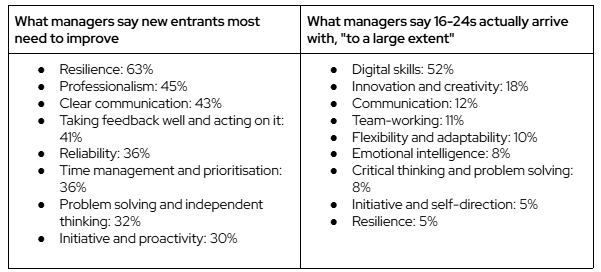
What would your managers say? Improving Gen Z retention (and Gen Z recruitment come to that) depends on closing this gap.
2. 2027 planning starts now
You now need two plans.
The first is the short term one for the gaps you can immediately fill. It might seem desperate and late, but some hastily arranged ‘you said we did’ can go a long way. It’s one thing not starting well, but another to shrug your shoulders and say you’ll get it right next time.
Then there is the longer term plan for September 2027 and anywhere in between where a cohort might arrive. It might sound trite to have to start so early but making these changes is not just about slide deck tweaking. It is also cultural and it means getting leaders and managers on board with behaving differently once induction and then probation are over.
The gap in skill set will not just be with the new recruits. It is at least as likely to be with the managers and those behaviours can be more deeply ingrained. They need to be ready for your 2027 cohort too.
My education background tells me that a missing GCSE exam season can still be significant. They may still have done one set of mock exams but the real thing is something else. It’s revising for something you might find very boring. It’s then sitting still for hours and being judged by a stranger against a standard you did not set. It’s finding out what you thought had gone well had gone badly months later. All of these help to develop resilience.
Exam seasons are formative experiences, as is the beginning of a professional career. Missing a key one can really count down the line.
3. Separate onboarding, induction and probation
These three processes have a tendency to overlap. Separate them.
The first two are more closely related. Nothing screams ‘we are inefficient as an organisation’ more than a clunky and unreliable onboarding process which no one truly owns. Is there really an excuse now for lanyards, log in details and ‘getting on the systems’ not to run smoothly? Gen Z is used to seamless, high-quality processes as standard. If a new recruit’s experience is ‘turn up and improvise for two weeks’ it’s a bad smell.
Induction and probation in particular have different aims. At the risk of sucking eggs territory, induction is the responsibility of the employer to ensure the employee has what they need and knows what they are doing. Meeting the probation standards is ultimately the responsibility of the employee, but like any similar process how well it runs says a lot about an employer (and specifically a manager).
Does a new recruit’s manager have any training in developing someone at the start of a career? Is there a written statement anywhere of what ‘professional’ means in your organisation, beyond a ten year old dress code? Can a 21 year old see, on a page, what they need to demonstrate to get through probation?
If the answer to most of those is no, you are running a readiness test on candidates that you would fail yourself.
CMI found that 86% of employed young people think it matters that their line manager has been trained to support someone at the start of their career. And 89% of managers who received that training said it helped them do exactly that. The intervention works but it’s not commonplace.
4. Develop your accidental managers
CMI reports that eight in ten UK managers are accidental managers, promoted for technical competence and given no formal management training. What is it in your organisation?
The truth is that many of them are very good and continue to get better over time.
Even with this it presents a credibility problem for Gen Z. They will know that managers require knowledge and skills which take time and practice to acquire. Why should they want to work for an organisation which leaves it to chance?
And from another perspective the person you have asked to convert an underprepared 21 year old into a functioning professional is, statistically, someone who was handed a team because they were good at the job below it.
It is not that managers are necessarily resistant to the idea (although those who have done it for years to a high standard may not feel motivated by it), but new ones in particular should not be expected to know that ‘giving feedback to someone who has never received feedback at work’ is a distinct skill with techniques attached.
This is the biggest single lever on the list and it is persistently the least funded. I have made this argument at greater length in underprepared, overwhelmed, fixable line managers.
If your L&D budget for the year is already accounted for then look again. The programme for the people receiving the graduates needs its own line in that budget.
Remember that
The 21 year olds arriving this September never sat a GCSE exam. Their first public examination was at 18. That gap may not have gone away. Gen Z in the workplace is not a single cohort, COVID means there will be variation.
The flood of applications for every graduate position means that recruitment is more expensive than it used to be. The implications for every hire that goes wrong are therefore more significant.
FAQ
Is Gen Z ready for work?
It depends who you ask! But that’s a key finding from the report. The gap between Gen Z employee and manager perception is enormous. Readiness is a two-way test and employers are currently only measuring one side of it too often.
What is an accidental manager?
An accidental manager is someone promoted for technical competence in the job below and given no formal management training. CMI reports that eight in ten UK managers fall into this category. It matters for early-career hires because giving feedback to someone who has never received feedback at work is a distinct skill with techniques attached, and it is not reasonable to assume an untrained manager has it.
Alex Atherton is a Gen Z speaker and generational workplace expert who helps UK organisations with recruitment, retention and the multigenerational workplace. A former secondary headteacher, he is the author of The Snowflake Myth.
How can I help you?
Talks, workshops and seminars - award-winning keynotes on recruiting and retaining Gen Z, understanding Gen Z and the multigenerational workplace. Speaker showreel here.
My book The Snowflake Myth is out now. For a free chapter, click here.
One to one coaching programmes for senior leaders.

Alex Atherton presenting to a group of senior leaders

Alex Atherton podcast episode with Stuart Elliott