Remote work, not AI, is breaking early entry jobs
‘All the entry-level jobs have disappeared because of AI’
It’s a compelling narrative, but it’s also mostly wrong.
A new Warwick University paper was published this month, analysing hundreds of millions of job postings.
The principal conclusion is that blaming AI is a ‘premature’ conclusion. When AI exposure and remote work exposure are tested in the same model, the AI effect on junior hiring largely disappears. The remote work effect doesn't.
There’s still a very significant issue for the early career job market, but hiring for senior jobs is up. In effect it is a deliberate reshaping of the workforce away from people who still need developing and towards people who already are.
Managers who work from home are less capable of offering the support and mentoring that young professionals need. But if the organisation needs those young professionals then something has to shift.
But what?
Here's four aspects to consider.
TL;DR
A new working paper of 650 million hires and job postings finds that the collapse in junior hiring across the UK, US, Canada and Australia isn't being driven by AI. It's being driven by remote work. WFH raises supervision costs and slows on-the-job learning. Firms then hire fewer juniors and more seniors. The senior-junior wage gap is widening. The career ladder isn't broken permanently. It's been tilted and Generation Z is paying the price.
1. Do your own research
The key lesson from Warwick University’s research is to test the impact of AI and Work From Home together.
There is an argument that the occupations most exposed to AI are very similar to the occupations most exposed to remote work. Software developers, accountants, management consultants and financial analysts all sit near the top of both lists.
When the impact of both AI and WFH are compared together the former shrinks away and the latter barely moves.
Take the roles in your organisation and put them against the findings in the report (see figure 2 from ‘the Broken Ladder: AI, Remote Work, and Early-Career hiring’). What are the implications for you?
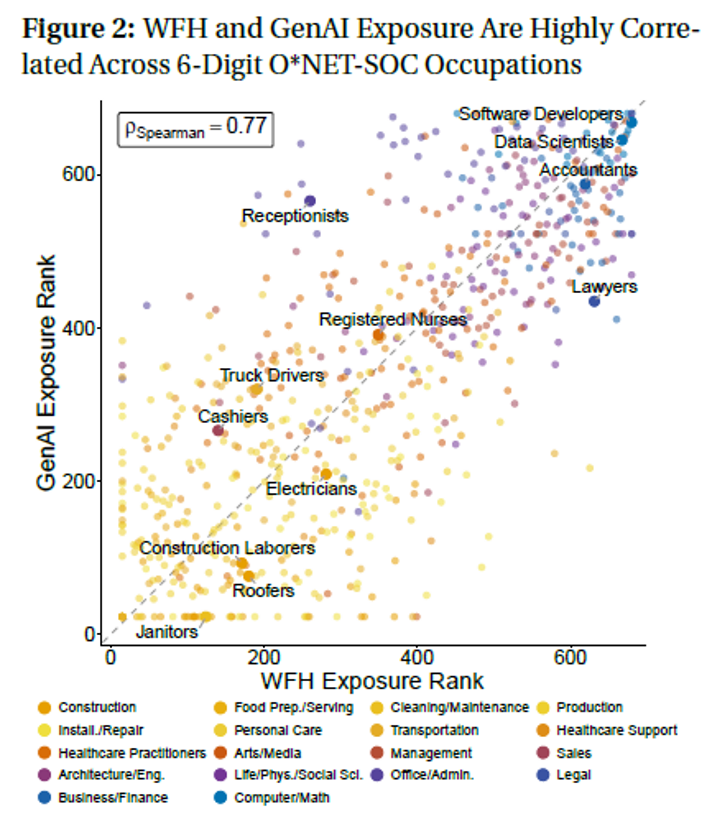
Lambert & Schindler - Warwick University - 2026
2. The supervision cost problem
Hire someone new and young and you commit some of your senior staff's time to them. They ask questions, get things wrong, need work checked and need feedback. And as I argue in The Snowflake Myth this is how Gen Z’s academic attainment is off the scale. They have learned how to improve.
In an office this happens at almost no cost and with little friction. You overhear a question, pop over and give two minutes of invaluable advice. It didn’t need a 30 minute slot in the calendar via an automated booking system, and you were more likely to catch the mistake before it goes to the client.
Remote work makes every one of those interactions deliberate. The short intervention becomes a stage in a process and not an impromptu event. In aggregate, it raises the cost of supervising each young professional.
And so organisations end up considering the senior time that junior workers consume. A higher supervision cost reduces that net contribution. The firm hires fewer juniors and more seniors.
This is a predictable response to a changed set of circumstances, but if organisations are acting as though this isn’t happening whilst damaging their own talent pipeline the costs outweigh the benefits.
What’s actually happening in your organisation?
3. Slower early-career learning
I don’t have the studies to point to, but I have my own experience so I will just say it. Most early-career development happens informally and through proximity. The young Gen Z professional watches the senior handle a difficult client, absorbs how decisions get made, picks up the tone of a message and sees how to solve a problem without reference to a manual.
None of this is on the training plan but all of it shapes the young pro. As a positive side effect it makes for better managers too, and for more informed senior managers as message get passed up the chain.
Remote working deprives young pros of their informal access to experienced colleagues. Even one office day per month, compared to fully remote, raises productivity and increases communication between workers and managers. I am not recommending it as a model but it can also be much better than nothing.
Hiring young professionals also represents an investment in future senior leaders. If they cannot develop there will be fewer of them, and (as Lambert and Schindler in ‘The Broken Ladder’ show) more senior leaders are hired.
4. Hiring young pros is an investment
And therefore not a transaction.
Let’s ask a stupid question, why hire a young professional at all? In the short term a senior is likely to be more productive per pound.
But the point is not the short term. Recruitment and onboarding costs are paid now, and the return shows up later. It is an investment.
Remote working for leaders means that the initial costs go up, particularly when impromptu supervision and guidance is less frequent and less accessible. The conditions under which young pros could be inexpensively developed have changed.
This is not about values, or generations either come to that. It is about investment decisions. If you want to get better value out of your young hires their managers need to be more physically present.
Your pipeline will not fix itself.
Remember that
The shift is substantial and the Warwick evidence is that workforces are reshaping. It’s not a temporary dip.
The fix is management practice, not policy. Senior folks will have to compromise.
FAQ
1. Is AI really not affecting junior hiring at all?
The paper doesn't claim AI has zero labour-market effect. It says that, up to 2025, AI's role in the relative hiring decline between junior and senior workers is much smaller than the role of remote work. Future effects of AI may show up more strongly as adoption deepens. The point is that the existing decline has a different driver from the one that is assumed.
2. What's the single most useful thing an L&D leader can do with this finding?
Reopen the hybrid policy and look at it as a development tool rather than a flexibility benefit. Specifically, protect in-person time for workers (and their managers) in their first two years of a career. The marginal return on the first day in the office can be high.
3. Does this mean fully remote firms can't develop juniors?
It means it's harder and more expensive, not impossible. Firms doing it well invest deliberately in structured mentoring, not ‘I’m here if you need me’. Leaders need to be more proactive than that.
Alex Atherton is a Gen Z speaker and generations expert who helps organisations navigate multigenerational workplace challenges. Author of The Snowflake Myth, he specialises in Gen Z recruitment and retention and leadership development.

At Davos this week for a speaking gig!
How can I help you?
Talks, workshops and seminars — I am an award-winning speaker. My talks include recruiting and retaining Gen Z, understanding Gen Z, overcoming the challenges of the multigenerational workplace plus those relevant to the topics below. Speaker showreel here.
My book The Snowflake Myth is out now — to receive a free chapter please click here.
One to one coaching programmes for senior leaders
Team coaching programmes — working IN a team is not the same as working AS a team and yet they are often treated as if they are the same. I help teams move from the former to the latter, and generate huge shifts in productivity and outcomes.