Your new recruit asks AI instead of you.
A third of Gen Z professionals now ask AI before they ask their manager.
The question a new starter doesn't ask is feedback their manager never gets.
-
A third of Gen Z professionals use AI for work questions before asking a manager or colleague, and 39% of UK professionals of all ages say they now ask their line manager fewer questions (Robert Walters, 2025). 70% of UK managers use generative AI for advice and guidance at work, and just 12% feel very confident managing AI-enabled teams (CMI, 2026). My argument is that the chatbot is a symptom.
I shall pause in anticipation of some tutting about a generation that won't pick up the phone.
The CMI found 70% of managers use generative AI for advice at work too. I’m going to assume that some of this includes how they manage their new recruit (fair)
What happens if both ends of the relationship stop asking each other? That lands on your desk, not IT's.
Here are four elements to consider.
1. Why don't Gen Z ask questions at work?
The short answer is because they don’t have to.
Large language models give you an instant answer, don’t make you wait for your monthly meeting, don’t roll their eyes, hold their heads in their hands in despair or make fun of you to their colleagues at lunchtimes.
I’m only half-joking.
Like it or not line managers now have the equivalent of an AI agent.
A LLM can have all the emails between you and them uploaded, every document, your bio on the company website all neatly within a Claude project.
The beginners’ guide to YOU is not only published but regularly updated. You have a chatbot unaffected by wall to wall Teams calls you commuted in for.
Why don’t you ask to see it? Of course it may not exist (and if it does, would you tell yourself?)
Even better, put it together yourself. Then ask AI how you need to develop as a manager.
2. Is Gen Z using AI instead of asking their manager?
This is a key distinction - there’s a big difference between asking BEFORE and asking INSTEAD.
And this may be yet another example of something which started with Gen Z (I can’t evidence that, just a hunch) then rolls out elsewhere.
The same research showed 39% of UK professionals, across every age group, say they ask their line manager fewer questions because of AI.
Again, FEWER doesn’t mean INSTEAD either.
So this isn't a Gen Z quirk. It's everyone.
‘I don’t know’ is my actual answer to this question, but my guess is you don’t either. That’s a cue to open up the conversation as it likely isn’t happening amongst your new recruits either and I imagine it isn’t at the higher tiers in the organisation.
Deloitte's 2026 Gen Z and Millennial Survey found AI being used as a career coach: 72% of Gen Zs report using it to seek career advice.
This is all perfectly healthy and I would advocate the use of AI as a thinking partner in the workplace. That’s no revelation, but the shift is to talk about how you do so including in line management and mentoring relationships.
Asking BEFORE a manager might be considered good practice. Asking every question INSTEAD is problematic.
3. An unasked question is feedback the manager never gets
Questions are how new starters learn the unwritten rules, and how managers find out what hasn't landed.
If the questions are taken away then both disappear.
AI can structure an email but it can't tell a graduate that this client hates being chased on a Friday, or that the finance director only reads the first line.
That knowledge lives in people. Learning to navigate workplace culture can be difficult, intimidating even, to someone in their first proper job. CMI (2026) found 21% of 18 to 24 year olds name doing so, and the ‘unspoken rules’ which come with it as one of their top career priorities.
New recruits and managers will have a very different idea as to what those ‘unspoken rules’ are.
The same CMI report said that a mere 12% of managers say young people in their organisation are ‘progressing as expected’. A big chunk of that gap is skills. And if some of it is a manager who never spotted what a new starter was getting wrong, because the new starter never asked, then the problem cannot be fixed.
The use of AI in the workplace needs a whole new conversation. To what extent is it happening in your workplace and with what impact?
4. Managers aren't trained for this either
The people best placed to notice the questions drying up are the least prepared for it.
Back to CMI (you really need to check this report out, sources at the bottom), just 12% of UK managers feel ‘very confident’ managing AI-enabled teams.
For all those ‘accidental’ managers, which is most of them* this only amplifies previous issues.
Robert Walters’ study put the ‘training gap’ at 71%. This is the share of UK managers who ‘hadn't received any guidance or training on managing teams in an AI-enabled workplace’ in 2025. More than half of those who had said it was too limited.
And their teams can tell. In Deloitte's 2026 survey only 20% of Gen Zs say their managers are guiding teams on how to integrate AI in practice.
In essence managers everywhere have been handed a new variable (a team that can get answers without them) without any instructions.
For those who didn’t receive management training before they started (that’s the * from above) it’s a lot to deal with.
What leaders should do next
Ask your managers where they get their own answers. One honest team meeting on who uses AI for what. You can't expect new starters to ask people if their managers don't.
Have the wider conversation - is AI used first or ‘instead’? And what is the impact of that? Are too many questions asked first when the new recruit needs to develop their judgement?
Take time out in the meeting to research together - that will tell you about your colleagues’ prompting skills as much as anything
FAQ
1. How do you get new starters to ask questions? Make asking cheaper than not asking. What access do you want new recruits to have to their manager? And vice versa?
2. Do managers need AI training? Yes, and most haven't had it. Just 12% of UK managers feel very confident managing AI-enabled teams, according to CMI's 2026 survey of more than 1,000 managers.
3. Isn't it better for graduates to ask AI than interrupt their manager? For drafting, often yes. For the development of judgement skills over time, I’m saying no.
Alex Atherton is a Gen Z speaker and generations expert who helps organisations navigate multigenerational workplace challenges. Author of The Snowflake Myth, he specialises in Gen Z recruitment and retention and leadership development.
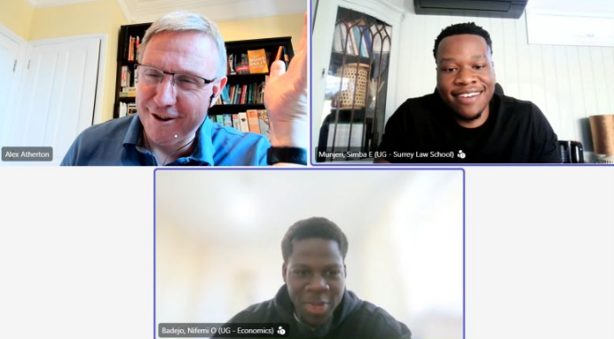
I enjoyed my time with Nifemi and Simba from the Launch Point this week.
It is is a free platform that aggregates the UK's top work experience, insight days, and apprenticeship programmes for Year 12-13 students — all in one place.
Early days for sure, but if you found the solutions weren't in place for you as a sixth form student then why not try to fix the problem yourself?
For those of you in schools looking to make life easier for your sixth formers then check this out.
How can I help you?
Talks, workshops and seminars - I am an award-winning speaker. My talks include recruiting and retaining Gen Z, understanding Gen Z, overcoming the challenges of the multigenerational workplace plus those relevant to the topics below. Speaker showreel here.
My book The Snowflake Myth is out now - to receive a free chapter please click here.
One to one coaching programmes for senior leaders
Team coaching programmes - working IN a team is not the same as working AS a team and yet they are often treated as if they are the same. I help teams move from the former to the latter, and generate huge shifts in productivity and outcomes.