Your new, young recruits were so enthusiastic during onboarding!
They nodded at your presentation about company values, asked good questions about career progression and were genuinely excited to start.
Six months later, three quarters of them are actively interviewing elsewhere.
Or at least those are the ones you know about.
What happened?
The uncomfortable truth is that Gen Z isn't rejecting your corporate culture because they're difficult or uncommitted.
They're rejecting it because they can see through it.
But what was there to see through? And how did they even see through it? Or when?
It’s not easy to navigate. But here’s four aspects to consider.
TL;DR
Gen Z rejects corporate culture because they've developed radar for inauthenticity. They've witnessed financial crises, corporate scandals, and broken institutional promises, so they demand evidence over empty values statements and consistency between words and actions. Traditional hierarchies, performative purpose statements, and rigid workplace structures feel fake to a generation with declining faith in institutions. They're not being difficult—they're refusing to accept what previous generations tolerated. The solution isn't cosmetic changes like breakout spaces and casual Fridays, but fundamental transformation: deliver on promises, create genuine psychological safety, and treat values as operational requirements rather than marketing copy. Get this wrong and your attrition rates will prove it.
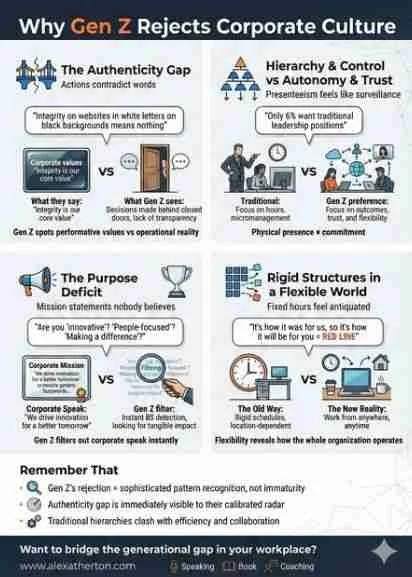
1. The Authenticity Gap: when actions contradict words
Organisations that refer to 'integrity' as a core value often arouse suspicion rather than confidence amongst Gen Z.
It’s a cliche. Meaningless. Yawn.
Gen Z has witnessed enough hollow corporate claims to recognise when values statements are performative rather than operational.
They need to see that commitments to diversity, equality and inclusion on your website are tangible in practice, not least in terms of representation across all organisational levels.
I was once in a roundtable session after I had given a talk, and one participant said
"We need to stop using the word 'integrity' on all our websites in huge white letters on a black background. It does not mean anything, and our young clients see through it”.
Today’s young professionals have grown up in an era where corporations routinely issue progressive statements whilst maintaining regressive practices, where environmental commitments appear alongside carbon-intensive operations and where people-first messaging coincides with mass redundancies.
Integrity really matters. But by putting it front and centre you only emphasise that you don’t really have a distinctive set of core values.
As an organisation you have the opportunity to prove who you say you are every day. That is the corporate culture that today’s best young professionals are looking for.
Your retention rates depend upon it.
2. Hierarchy & Control vs Autonomy & Trust
Traditional corporate culture with an over-emphasis on hierarchy and presenteeism clash with Gen Z's expectations of workplace autonomy.
If a requirement to be in is surveillance disguised as management, or if contribution is measured by hours at a desk rather than output it will only feel both outdated and disrespectful to the calibre of candidate you wish to recruit.
That’s not to say you shouldn’t expect your young colleagues to be physically present. I’ve worked with organisations in the course of this research where 5 days a week in the office is their model for everyone, no exceptions.
Do they put some people off with this? Yes they do, but they are super clear about their rationale for doing so. And it’s not ‘hierarchy and control’ related. It’s clearly not ‘because we say so’ and they have the testimonials from their young staff to back it up. It is possible to buck this particular workforce trend and make it work for everyone in your multigenerational workplace..
For young professionals the corporate ladder represents an increasingly unappealing proposition. Gen Z has witnessed middle management roles become ‘too high stress, low reward’, leading to a severe reduction in those who want traditional leadership positions.
Why climb a hierarchy that doesn't adequately reward the climb?
Corporate cultures built around the assumption that everyone aspires to management positions, that physical presence indicates commitment and that hierarchy deserves automatic deference will find themselves increasingly rejected by a generation. These premises are not seen by Gen Z as valid or desirable.
What do your young staff actually say about your corporate culture? How do you know?
3. The Purpose Deficit: mission statements nobody believes (or remembers)
Are you ‘innovative’?
Or ‘people focused’?
Is your ‘commitment to making a difference’ your stated hallmark?
You might be right and your colleagues might feel the same. But that doesn’t mean you will get through Gen Z’s sophisticated filters for corporate speak. They will recognise when language is designed to impress stakeholders rather than guide genuine organisational behaviour.
If the only talk about your ‘mission’ is when people arrive or make a big mistake then the balance is in the wrong place.
One key characteristic of Gen Z is that they can distinguish immediately between organisations where purpose genuinely drives decisions and those where it serves as window dressing. The latter also reveals issues with workforce engagement, and with the full multigenerational workplace, not just Gen Z.
The bar might be higher than you think it is. It is possible that you have done all of this in the right way but the finished product doesn’t persuade others.
With that in mind although alignment matters, but in this day and age it is defined through observable actions rather than aspirational statements. Expect no credit for good intentions, although you will get some if you state candidly that you are not yet where you want to be.
Even better if you make clear that you want new staff who can help to close that gap.
4. Rigid workplace structures in a flexible world
Insisting on rigid workplace structures around fixed office hours, mandatory in-person attendance and inflexible holiday policies increasingly feels antiquated.
This is particularly the case for Gen Z who grew up with unprecedented flexibility in how, when and where they engaged with education, socialising, and entertainment.
Here’s the thing their leaders and managers might miss. Anything that presents as ‘it’s how it was for us, so it’s how it will be for you’ is a bad look, red line even. And it gets worse when senior, or older, staff have access to flexibilities which are not open to everyone.
This issue is not just about flexibility of working patterns. It’s also about what it reveals about how the rest of the organisation operates.
How do you solve problems? Or tackle emergencies? How do you collaborate or not? What is your approach to DEI (and do you mean it?)
How working conditions and HR policies operate as a portal about what it’s like to work for you in general.
Organisations that cannot adapt workplace structures to accommodate how Gen Z actually works most effectively will simply lose them to competitors who can.
Remember that
Gen Z rejects corporate culture not from immaturity but from sophisticated pattern recognition after witnessing financial crises, institutional failures and repeated broken promises throughout their formative years. It’s a scepticism which is based on evidence.
The authenticity gap between stated values and operational reality is immediately visible to Gen Z, who've developed more finely calibrated radar for performative corporate jargon than you might ever imagine.
Traditional hierarchical structures, rigid workplace policies, and career progression built around ‘who knows who’ fundamentally clashes with what your best young staff are looking for. It’s seen as inherently inefficient as much as anything, when collaboration is how you get things done.
Frequently Asked Questions
How can organisations demonstrate authentic values to Gen Z?
Start by involving Gen Z employees in defining what values actually mean in operational practice. Even the concept of values can mean different things to different people.
Where might anyone expect to see them in action? What might happen that causes them to be restated? What influence do they have day to day? How can, and should, staff hold each other to account on this? If a junior member of staff sees a senior one not uphold them what should they do?
And so on. This topic has many in-built assumptions.
What specific workplace structures need changing to rebuild Gen Z trust in corporate culture?
The focus needs to be on outcomes, and ideally some precision around the metrics. Then work backwards from that point.
If you still end up with a focus on attendance and the quantity of hours then you do, but I would query it (as would they).
Most fundamentally, ensure there is genuine two-way dialogue where Gen Z input influences decisions rather than being collected and ignored. Trust rebuilds through consistent demonstration that employee voices matter and organisational responses prove it.
If ‘they said, you didn’t’ is the default model, expect your attrition rates to suffer.
How do you balance traditional corporate hierarchy with Gen Z expectations of autonomy?
Hierarchy and influence are not the same thing.
Your young staff will expect to have the opportunity to pitch in and for it to be taken seriously, but that is not the same as having a management position.
Older staff in a multigenerational workplace often equate the two and that ‘you have to put in your years to have a voice around THAT table’. Gen Z tends to see it quite differently.
Alex Atherton is an award-winning Gen Z speaker and generations expert who helps organisations navigate multigenerational workplace challenges. Author of The Snowflake Myth, he specialises in Gen Z recruitment and retention, and leadership development.
How can I help you?
Talks, workshops and seminars - I am an award-winning speaker. My talks include recruiting and retaining Gen Z, understanding Gen Z, overcoming the challenges of the multigenerational workplace plus those relevant to the topics below. Speaker showreel here.
My book The Snowflake Myth is out now - to receive a free chapter please click here.
One to one coaching programmes for senior leaders who are swamped by their jobs so they can thrive in life. Click here to discover where you are on your journey from Frantic to Fulfilled? Just 5 minutes of your time and you will receive a full personalised report with guidance on your next steps.
Team coaching programmes - working IN a team is not the same as working AS a team and yet they are often treated as if they are the same. I help teams move from the former to the latter, and generate huge shifts in productivity and outcomes.