Gen Z Leadership Insights for Millennial Managers
You were the future once.
And of course you still are, in your thirties and early forties.
But that can still mean that the cultural gap between a 35-year-old Millennial manager and a 22-year-old Gen Z employee is wider than you realise.
You most likely grew up before the digital revolution really got going.
Your first smartphone was not in your hands while still at primary school.
You may not have started a business while still on probation.
The jibes and stereotypes that you heard about young professionals from your managers while starting out now apply to someone else.
Plenty of Millennial managers of Gen Z employees are wondering why their tried-and-tested approaches aren't working.
Treating them as ‘Millennials Lite’ is a strategic error that will cost you talent.
So what to do?
Here's four aspects to consider.
TL;DR
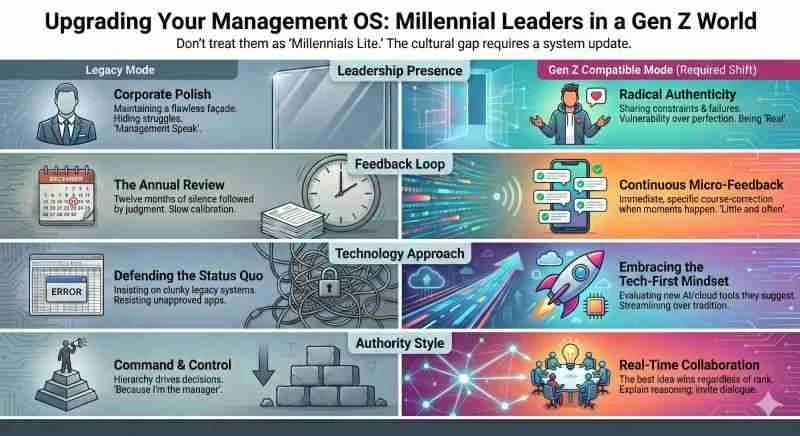
Millennial managers often underestimate the cultural gap with Gen Z employees. Success requires abandoning the corporate façade for authentic leadership that shares struggles and constraints rather than maintaining polish. Replace annual performance reviews with continuous micro-feedback that provides immediate, specific calibration when moments happen, not months later. Embrace their tech-first approach by evaluating new tools they suggest rather than defending legacy systems.. Finally, shift from command-and-control to collaborative leadership where the best idea wins regardless of rank. Gen Z will question your decisions not from disrespect but genuine curiosity, so explain reasoning and remain open to better arguments.
1. Lead with Authenticity: ditch the corporate façade
If there's one thing that triggers Gen Z's immediate distrust, it's corporate polish and management speak.
This generation has grown up in an era of fake news, filtered Instagram lives and performative corporate statements that promise everything whilst delivering nothing.
They've developed a finely tuned radar for inauthenticity, and when you push corporate jargon or maintain a perfect, polished exterior, you can instantly lose their trust.
The concept that professionalism means maintaining a certain distance or presenting a flawless image, but Gen Z respects vulnerability far more than perfection.
This can be problematic when gaining, and surviving, in your current role meant doing exactly that. It was what was expected of you. Maintain the company sheen. Show no vulnerability. Keep the corporate dirty washing hidden.
There’s a balance to strike, particularly if the top table you sit around or report to wants to carry on like it’s 1995. You have to be a lot more of one thing to one group and something else to another. Not easy.
But when you share your own struggles with work-life balance, acknowledge a project failure and what you learned from it, explain the real constraints you're working within rather than pretending they don't exist, you build credibility. You become the manager that Gen Z employees want to have.
They don't expect you to be perfect; they expect you to be real.
2. Provide continuous feedback, not annual reviews
The annual performance review is a dinosaur from an era of slow-moving information and stable career trajectories.
For a generation raised on instant likes, real-time comments, immediate analytic, and constant data streams, waiting twelve months to hear how they're performing feels like working in a complete vacuum. They will have left before that comes around.
They've grown up in an environment where feedback is instant and frequent, and your workplace feedback systems need to reflect that reality.
An annual summary that brings it together, maybe makes a decision on pay and offers strategic direction - absolutely. In fact, I would argue still essential. But it cannot be the only point of contact.
Your best Gen Z young professionals won’t allow it to be either. They will either demand more explicitly or leave to find it somewhere else.
Micro-feedback that provides continual calibration rather than annual judgment is the way to go for Millennial managers. When a Gen Z employee does well in a meeting, tell them immediately afterwards what specifically they did well and why it mattered. When they make a mistake or miss the mark, course-correct quickly rather than saving up criticisms for a quarterly review where the context has been lost.
I will draw a distinction between ‘continual’ and ‘continuous’, not least to safeguard your own sanity. ‘Little and often’ is the way to go, not a conversation that never ends or avoids an expectation that your direct report actually has to go and do the thing.
3. Embrace their tech-first world
You may already be tech-savvy by anyone’s definition.
And given that differences within generations are far bigger than differences between you may be the most tech-savvy in your organisation, more than any young employee can match.
But I will keep open the possibility that, on average, your Gen Z employees may run rings around Millennial managers when it comes to technology.
They will find the fastest, most efficient way to automate a task using artificial intelligence or discover a new application you've never heard of that solves a problem in minutes rather than hours.
Maybe the AI app is not yet ‘approved’ from above or doesn’t fit within legacy systems. But that in itself is not a reason to push forward.
Gen Z employees tend to view technology as an extension of themselves and their capabilities.
When you force outdated processes on digital natives, when you insist they use the clunky spreadsheet system from 2010 instead of the streamlined cloud-based tool they've found, you're essentially asking a carpenter to build a house without using power tools.
If a Gen Z employee suggests implementing a new piece of software to replace your manual process, your first instinct should be to listen and evaluate rather than defend the status quo.
They're not trying to make your life difficult; they're trying to work smarter.
They might also take longer to find the very best solution, because there’s not just one decent possibility available but a whole stack.
This generation expects to use the best available tools for the job. Organisations who are the best at Gen Z retention embrace this level of agility.
4. Collaborate in real time
The days of ‘command and control’ management as the default mode day in day out are finished.
The Gen Z workforce respects competence and expertise, not rank or title alone.
They will question your decisions, not out of disrespect or insubordination, but out of a genuine desire to understand the reasoning and potentially improve the process or outcome.
If you rely on ‘because I'm the manager’ or ‘because I said so’ as your authority, you can expect to be quoted on Glassdoor sooner rather than later.
Organisations do need hierarchy, but they do not need to operate perpetually in hierarchical mode.
Leaders do need to pace set, set expectations and give orders. But not all day every day.
Create a genuinely flat culture where the best idea wins regardless of who proposes it or their position in the hierarchy.
Invite the intern to the strategy meeting and actually listen to their perspective.
Ask the new recruit for their opinion on the product roadmap.
When someone challenges your decision, see it as an opportunity for dialogue rather than a threat to your authority.
Power and influence are not symbiotically related with Gen Z. They know that they may not get to make the decision, but they do expect to be engaged and for engagement to mean something.
This doesn't mean you can't make final decisions or that everything is decided by committee.
It means you explain your reasoning, you remain open to being convinced by better arguments, and you give credit where it's due regardless of seniority.
When you dismantle unnecessary hierarchy, you unlock innovation because people at all levels feel empowered to contribute their ideas rather than simply executing orders from above.
Remember that
The Generation Z workforce comprises over 25% of the 2026 workforce and has different expectations from previous generations, shaped by digital nativity, economic instability and pandemic disruption. Your adaptation is not optional.
Authentic leadership that prioritises vulnerability over polish, provides continuous micro-feedback rather than annual reviews and normalises mental health conversations can make a significant difference to retention rates. Gen Z engagement is a prize worth winning.
Millennial managers are often ‘stuck in the middle’ between senior leaders and younger new recruits. It is not easy, but there is a way through.
FAQ
1. How often should millennial managers provide feedback to Gen Z employees?
First things first ‘millennial managers’ are the same as any other. This article focuses on the idea that Gen Z can still present challenges even to those only a little older. As a generations speaker, I recommend millennial managers provide immediate, specific feedback when moments happen. Praise what went well in meetings right afterwards and correct mistakes quickly rather than saving criticisms for quarterly reviews. This approach reflects Gen Z characteristics of expecting real-time information, similar to the instant likes and analytics they've grown up with in their digital-first world.
2. What is the biggest mistake millennial managers make with Gen Z?
The biggest mistake is treating Gen Z employees as 'Millennials Lite'—assuming similar approaches will work for both generations in the multigenerational workplace. Gen Z has fundamentally different expectations shaped by economic instability, pandemic disruption, and growing up with smartphones from primary school.
3. Why does Gen Z question management decisions so frequently?
Gen Z employees question decisions not from disrespect or insubordination, but from genuine curiosity to understand reasoning and potentially improve outcomes. This Gen Z characteristic stems from their collaborative, information-rich upbringing where the best idea wins regardless of source.
Alex Atherton is an award-winning Gen Z speaker and generations expert who helps organisations navigate multigenerational workplace challenges. Author of The Snowflake Myth, he specialises in Gen Z recruitment and retention, and leadership development.
How can I help you?
Talks, workshops and seminars - I am an award-winning speaker. My talks include recruiting and retaining Gen Z, understanding Gen Z, overcoming the challenges of the multigenerational workplace plus those relevant to the topics below. Speaker showreel here.
My book The Snowflake Myth is out now - to receive a free chapter please click here.
One to one coaching programmes for senior leaders who are swamped by their jobs so they can thrive in life. Click here to discover where you are on your journey from Frantic to Fulfilled? Just 5 minutes of your time and you will receive a full personalised report with guidance on your next steps.
Team coaching programmes - working IN a team is not the same as working AS a team and yet they are often treated as if they are the same. I help teams move from the former to the latter, and generate huge shifts in productivity and outcomes.